Bundzy
Caduceus Medical Embroidery Design
Caduceus Medical Embroidery Design
Couldn't load pickup availability
Caduceus Medical Embroidery Design: Healthcare Symbol Machine Embroidery File
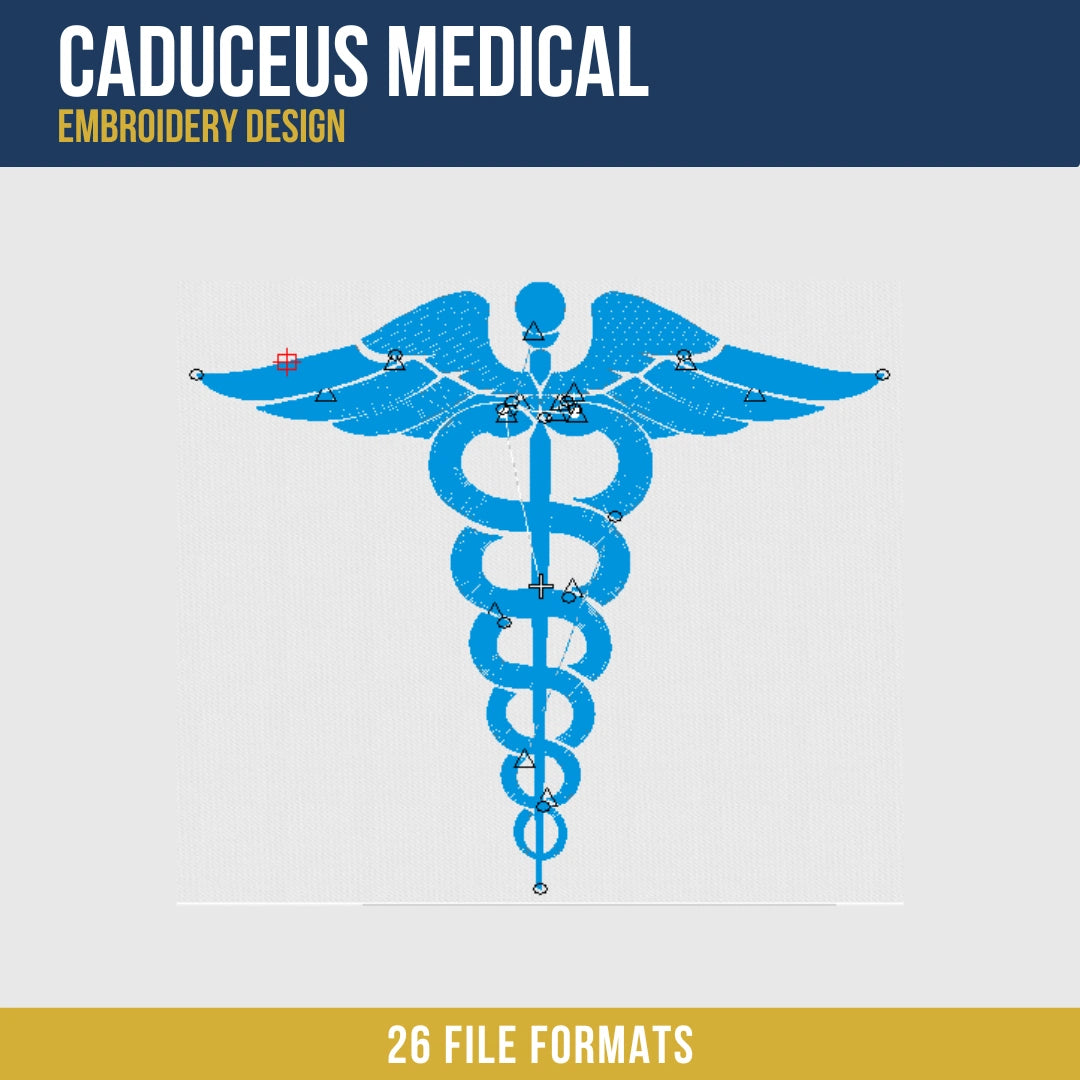
The Caduceus Medical embroidery design is a large-format rendering of the winged herald's staff symbol in a single-color sky blue satin construction. The design features two serpents coiling in mirrored spirals up a central vertical staff, a pair of spread wings extending from the top of the staff, and a spherical orb capping the staff above the wing junction. The entire composition is executed in a single medium sky blue thread with tonal depth created entirely through stitch direction variation rather than color change. Total stitch count is 10,496 stitches at 7.90 x 6.94 inches.
What makes this design technically distinct from other large-format embroideries in the same collection is the requirement to render three-dimensional volume across every major element using only stitch angle shifts within a single color. The serpent bodies, wing feather layers, staff shaft, and orb are all the same thread color, meaning the only tool available to suggest curvature, depth, and form separation between overlapping elements is the direction from which the satin stitches run. This makes the angle mapping strategy the entire design language rather than a supporting technique, a constraint that does not apply to any multi-color design in the collection.
Design Details
The dominant elements are the two serpents, each rendered as a thick rounded satin body that coils in an S-curve around the vertical staff. The serpent bodies cross the staff at four points along its length, and at each crossing the foreground serpent is stitched over the staff and the background serpent with a stitch direction shift that implies the body curving toward the viewer. The heads of both serpents face outward at the top of the coil, with small circular eye details and slightly open jaw profiles. The central staff is a narrow vertical satin column running the full height of the design, visible between and beneath the serpent coils. At the top of the staff, two wings spread horizontally, each wing composed of multiple feather layers rendered with fanned satin columns whose angles radiate from the wing root outward toward the feather tips. The feather layering within each wing uses stitch direction shifts between rows to create the impression of overlapping plumage. The spherical orb at the staff apex is a small circular satin fill with radial stitch angles producing a rounded highlight effect. At the base of the design, the staff terminates in a small ringed foot detail. The entire composition is sky blue throughout with no color stops.
Size Guide
| Size | Dimensions | Stitch Count |
|---|---|---|
| Standard | 7.90 x 6.94 in | 10,496 |
Formats Included
- PES, PEC - Brother, Baby Lock, Bernina
- DST, DSB - Tajima
- JEF, SEW - Janome, Elna
- VP3, VIP, SHV, HUS - Husqvarna Viking
- PCS, PCQ, PCD - Pfaff
- XXX - Singer
- ART - Bernina software
- 000 - Singer/generic
- 100 - Toyota
- CND - Melco/Conde
- CSD - Singer/POEM
- DGT - Barudan
- DSZ - Tajima older
- EMD - Elna
- EXP - Melco/Bernina
- INF - design info
Digitizing Quality
The primary technical challenge in this design is engineering readable depth separation between the two serpent bodies and the staff at each of the four crossing points, using only stitch angle contrast within a single thread color. At each crossing, the foreground serpent body must visually lift away from both the staff and the background serpent without any color boundary to define the separation. This was achieved by assigning perpendicular stitch angles to adjacent overlapping elements at each crossing zone, so that the change in light reflection at the boundary between elements substitutes for the color contrast that would normally perform this function.
The second challenge was the wing feather layering. Each wing contains multiple overlapping feather rows, and within a single color, the boundary between one feather row and the next is only visible if the stitch angles of adjacent rows diverge enough to produce a visible sheen difference. Too little angle divergence and the feather rows merge into a flat filled surface. Too much divergence and the boundary reads as a harsh line rather than a soft feather overlap. Each feather row boundary was calibrated to a specific angle differential that produces a soft tonal separation consistent with the look of layered plumage at normal viewing distance.
The third challenge was the serpent coil sequencing across a 7.90-inch design footprint. With the two serpents crossing the staff four times each over the full height of the composition, a poorly planned stitch sequence produces either excessive jump threads between crossing segments or visible density buildup at the crossover zones where multiple passes accumulate. The coil paths were sequenced to complete each continuous serpent body segment in a single pass before jumping to the next, with crossing zones receiving a flattened underlay to prevent thread pileup where three elements converge.
License
This file is licensed for use on finished physical goods only. You may stitch and sell embroidered items made from this design. The digital files themselves may not be resold, redistributed, shared, or included in any digital product bundle.
Instant Download
Your files are available immediately after purchase. This listing includes 1 size in all 26 embroidery formats, zipped and ready to transfer directly to your machine or software. No waiting, no requests needed. Add to cart, download, and stitch.