Bundzy
Classic Laurel Wreath Embroidery Design
Classic Laurel Wreath Embroidery Design
Couldn't load pickup availability
Classic Laurel Wreath Embroidery Design: Symmetrical Leaf Frame Machine Embroidery File
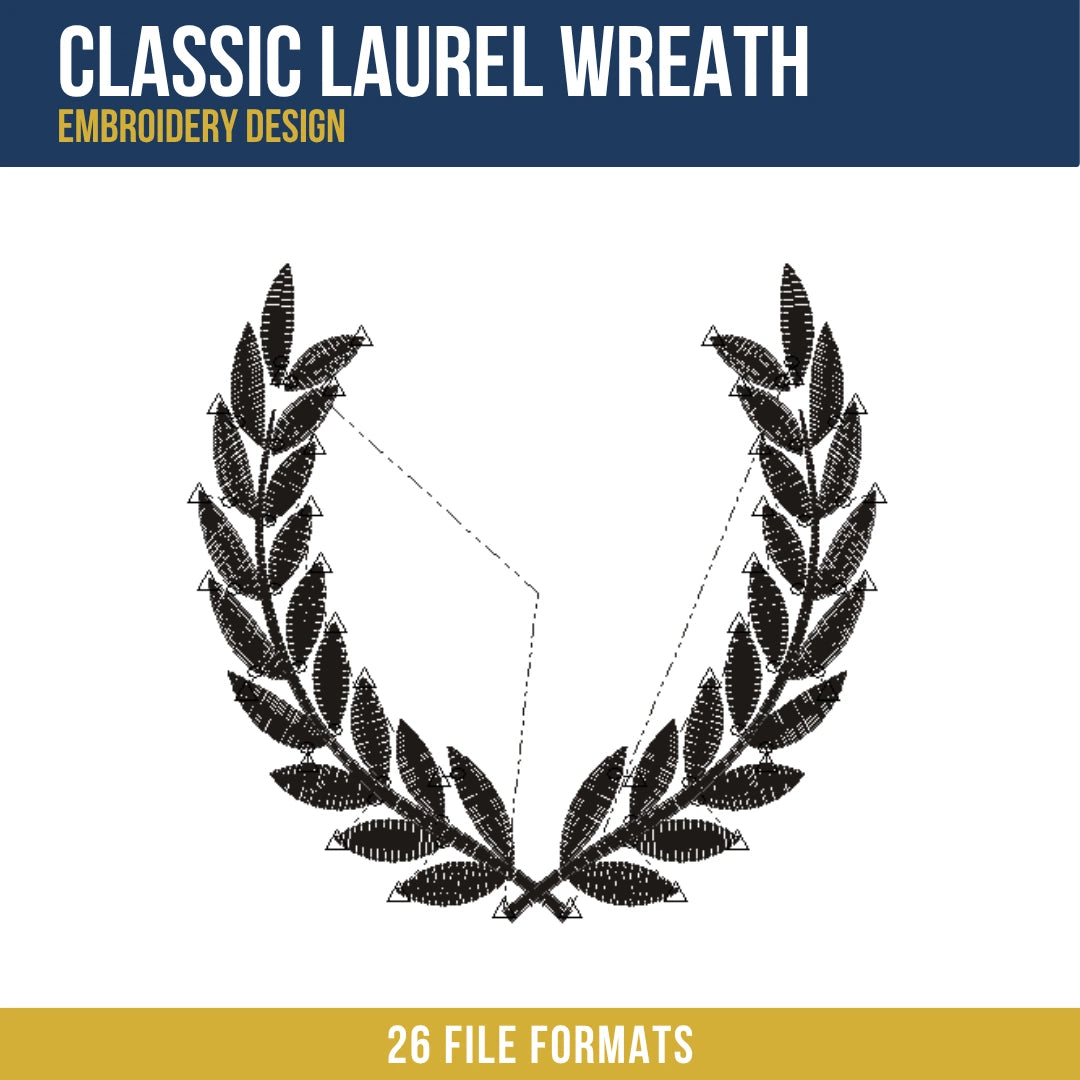
The Classic Laurel Wreath embroidery design is a symmetrical open wreath formed by two mirrored laurel branches crossing at the base, each branch carrying a graduated row of individually filled laurel leaves that arc upward and inward to frame a clear central negative space. The entire design is executed in a single dark charcoal thread, with each leaf rendered as a satin-filled oval with a visible central vein line created by a stitch direction split running along the leaf's long axis. Total stitch count is 5,854 stitches at 4.95 x 4.79 inches.
What makes this design technically distinct from the Blossom Floral Wreath in this collection is the construction logic of the individual leaf elements. The Blossom Wreath uses organic, asymmetric petal fills that vary in size and angle across the composition. The Classic Laurel Wreath is built on strict bilateral symmetry, with every leaf on the left branch having an exact mirror counterpart on the right. This means any digitizing inconsistency in leaf shape, vein placement, or satin density is immediately visible as a symmetry break when the two halves are compared side by side, placing a higher accuracy demand on each individual leaf than an asymmetric floral arrangement would require.
Design Details
The dominant elements are the two laurel branches, each composed of a central stem with leaves alternating left and right along its length. The stems are rendered as narrow satin columns that taper slightly as they approach the tip of each branch, with the two stems crossing and overlapping at the bottom center of the composition. Each leaf is an elongated oval satin fill, slightly pointed at both ends, with the satin stitches running perpendicular to the leaf's long axis on each half of the leaf divided by the central vein. The vein is formed by reversing the stitch direction at the midline of each leaf, creating a natural-looking shadow line without requiring a separate color or outline run. Leaves are arranged in alternating pairs along each stem, graduating in size from smaller leaves at the branch tips to larger leaves at the midsection, then tapering again toward the crossed base. The stem crossing at the bottom is digitized with one stem stitching over the other, creating a clean overlap without thread buildup. The overall composition is open at the top center, leaving a clear interior field suitable for monogram, crest, or text additions. The single-color dark charcoal construction makes the design adaptable to any garment color that provides sufficient contrast.
Size Guide
| Size | Dimensions | Stitch Count |
|---|---|---|
| Standard | 4.95 x 4.79 in | 5,854 |
Formats Included
- PES, PEC - Brother, Baby Lock, Bernina
- DST, DSB - Tajima
- JEF, SEW - Janome, Elna
- VP3, VIP, SHV, HUS - Husqvarna Viking
- PCS, PCQ, PCD - Pfaff
- XXX - Singer
- ART - Bernina software
- 000 - Singer/generic
- 100 - Toyota
- CND - Melco/Conde
- CSD - Singer/POEM
- DGT - Barudan
- DSZ - Tajima older
- EMD - Elna
- EXP - Melco/Bernina
- INF - design info
Digitizing Quality
The primary technical challenge in this design is maintaining exact bilateral symmetry across all leaf elements at a 4.95-inch width. Because the left and right branches are mirror images, any variation in leaf satin density, vein placement, or oval proportions between corresponding leaf pairs produces a visible asymmetry that draws the eye immediately. Each leaf was digitized from a master shape and mirrored precisely, with density and underlay settings matched identically between branches rather than allowing the mirroring process to introduce incremental differences through independent path adjustments.
The second challenge was the central vein construction within each leaf. The vein line is not a separate stitched element but a directional split in the satin fill, where stitches on the left half of the leaf run at one angle and stitches on the right half run at the mirror angle, meeting at the midline to create a shadow crease. Getting this split to read as a clean, centered vein rather than a rough seam required the midline path to be mapped precisely along the leaf's long axis, with stitch endpoints on both sides landing at the same needle positions along the split to avoid a ragged or offset joint at the center.
The third challenge was the stem crossing at the base of the composition. At the overlap point, one stem stitches over the other, and the underlapping stem must terminate cleanly at the crossing boundary without leaving a visible edge or gap beneath the overlapping stem. The crossing sequence was planned so the underlapping stem terminates flush with the overlap zone boundary and the overlapping stem covers the termination edge completely, producing a clean crossed appearance with no visible raw endpoints at the junction.
License
This file is licensed for use on finished physical goods only. You may stitch and sell embroidered items made from this design. The digital files themselves may not be resold, redistributed, shared, or included in any digital product bundle.
Instant Download
Your files are available immediately after purchase. This listing includes 1 size in all 26 embroidery formats, zipped and ready to transfer directly to your machine or software. No waiting, no requests needed. Add to cart, download, and stitch.