Bundzy
Geometric Diamond Embroidery Design
Geometric Diamond Embroidery Design
Couldn't load pickup availability
Geometric Diamond Embroidery Design: Faceted Diamond Gem Machine Embroidery File
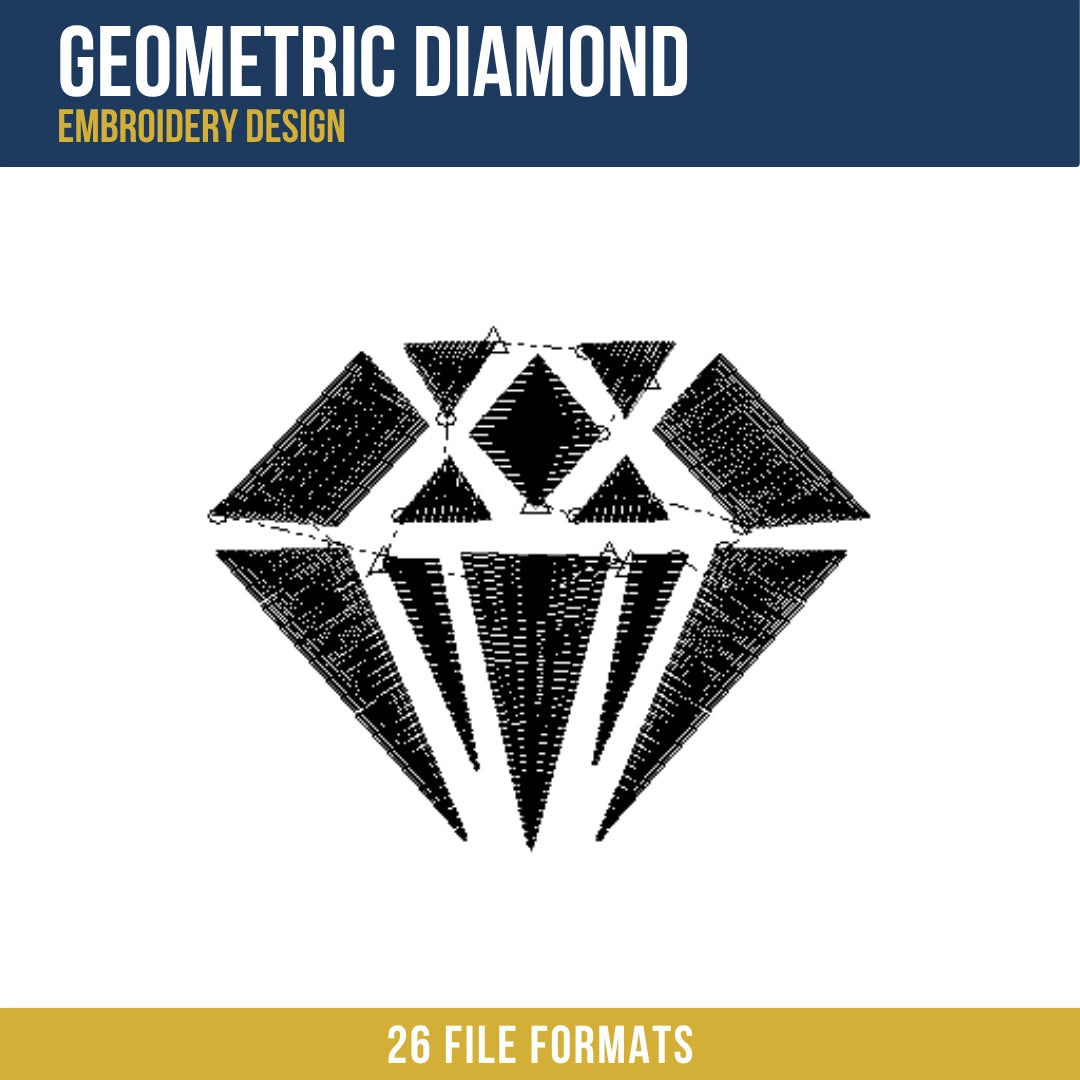
The Geometric Diamond embroidery design is a single-color flat graphic composition featuring a stylized cut diamond rendered in dark black satin fill, constructed from individual facet panel fills separated by clean unstitched gap lines that replicate the facet divisions of a brilliant-cut gemstone. The design is divided into a flat crown section at the top and a deep pavilion section below, with the white fabric gap lines between facets serving as the structural design element that creates the illusion of a multi-faceted gem surface using only one thread color. Total stitch count is 2,767 stitches.
What distinguishes this design from other geometric or jewel embroidery files in a graphic collection is its use of negative space gap lines as the primary facet definition method rather than outline stitching or color variation. Unlike a filled diamond design where facet divisions are marked with a contrasting outline thread, every facet boundary in this composition is formed by leaving the fabric unstitched between adjacent fill panels, meaning the precision of the gap width and straightness determines the entire visual clarity of the gemstone facet structure.
Design Details
The crown section occupies the upper portion of the composition and is built from seven individual facet fills arranged in the characteristic diamond crown layout. The central top element is a small square or rhombus fill representing the table facet, flanked on either side by two small triangular fills representing the star facets. On the left and right outer edges of the crown, two larger trapezoidal fills form the bezel facets, each angled inward toward the center. All crown facets are separated from each other by clean straight unstitched gap lines that converge toward the crown center.
A horizontal unstitched gap line divides the crown from the pavilion section below, representing the girdle line of the gemstone. The pavilion section is built from five individual triangular fills that taper downward to the culet point at the bottom center of the design. The central pavilion fill is the largest and tallest triangle, pointing straight downward. On either side, two progressively shorter and wider triangular fills angle outward toward the lower left and lower right, with the outermost pavilion facets being broad shallow triangles at the outer edges. All pavilion facets are separated by straight unstitched gap lines that radiate downward from the girdle line to the culet point. Each individual facet fill uses a directional satin stitch angle specific to that facet's orientation, creating subtle surface variation between adjacent panels despite the single thread color.
Size Guide
| Size | Dimensions | Stitch Count |
|---|---|---|
| 2 inch | 2.76 x 2.13 in | 2,767 |
Formats Included
This design is delivered in 26 file formats compatible with all major embroidery machine brands: PES, PEC (Brother, Baby Lock, Bernina); DST, DSB (Tajima); JEF, SEW (Janome, Elna); VP3, VIP, SHV, HUS (Husqvarna Viking); PCS, PCQ, PCD (Pfaff); XXX (Singer); ART (Bernina software); 000 (Singer/generic); 100 (Toyota); CND (Melco/Conde); CSD (Singer/POEM); DGT (Barudan); DSZ (Tajima older); EMD (Elna); EXP (Melco/Bernina); INF (design info).
Digitizing Quality
The primary technical challenge in this design is maintaining consistent gap line width between all facet fills across the full composition. Because the facet boundaries are formed entirely by unstitched fabric rather than applied lines, any pull in the adjacent fill zones will narrow or widen the visible gap at that boundary. Pull compensation for every facet fill is calibrated to draw inward away from the gap lines so the unstitched channels remain at their intended width after the fabric responds to the stitch tension. Inconsistent gap widths between facets would make the diamond structure read as irregular and undermine the geometric precision that defines the design.
Each facet fill uses a stitch angle specific to its panel orientation, which means the fill angle changes at every gap boundary across the composition. Managing these angle transitions so that adjacent facet fills do not visually merge at their boundaries, despite sharing the same thread color and density, required deliberate angle differentiation between neighboring panels. The crown bezel facets, the table facet, the star facets, and each pavilion facet all use distinct fill angles chosen to maximize the visual contrast between adjacent panels under normal lighting conditions on fabric.
The triangular pavilion fills that taper to the culet point at the lower center of the design present the same sharp-point construction challenge as any tapering satin fill at this scale. The five pavilion fills all converge toward the same culet point, meaning five fill zones must terminate cleanly within a very small area at the bottom tip without creating a dense stitch buildup or a ragged multi-layered point. The pavilion fills are sequenced and sized so that their terminal stitches converge to the culet without overlapping, keeping the tip clean and the overall design flat at its lowest point.
License
This design is licensed for personal use and small commercial production of finished physical goods. You may sell embroidered items created with this file. The digital files themselves may not be resold, redistributed, shared, or included in any digital product collection.
Instant Download
Files are available immediately after purchase with no waiting and no shipping. This listing includes 1 size in 26 embroidery formats. Complete your purchase and download your full file package directly from your order confirmation.