Bundzy
Graceful Lily Embroidery Design
Graceful Lily Embroidery Design
Couldn't load pickup availability
Graceful Lily Embroidery Design: Botanical Lily Line Art Machine Embroidery File
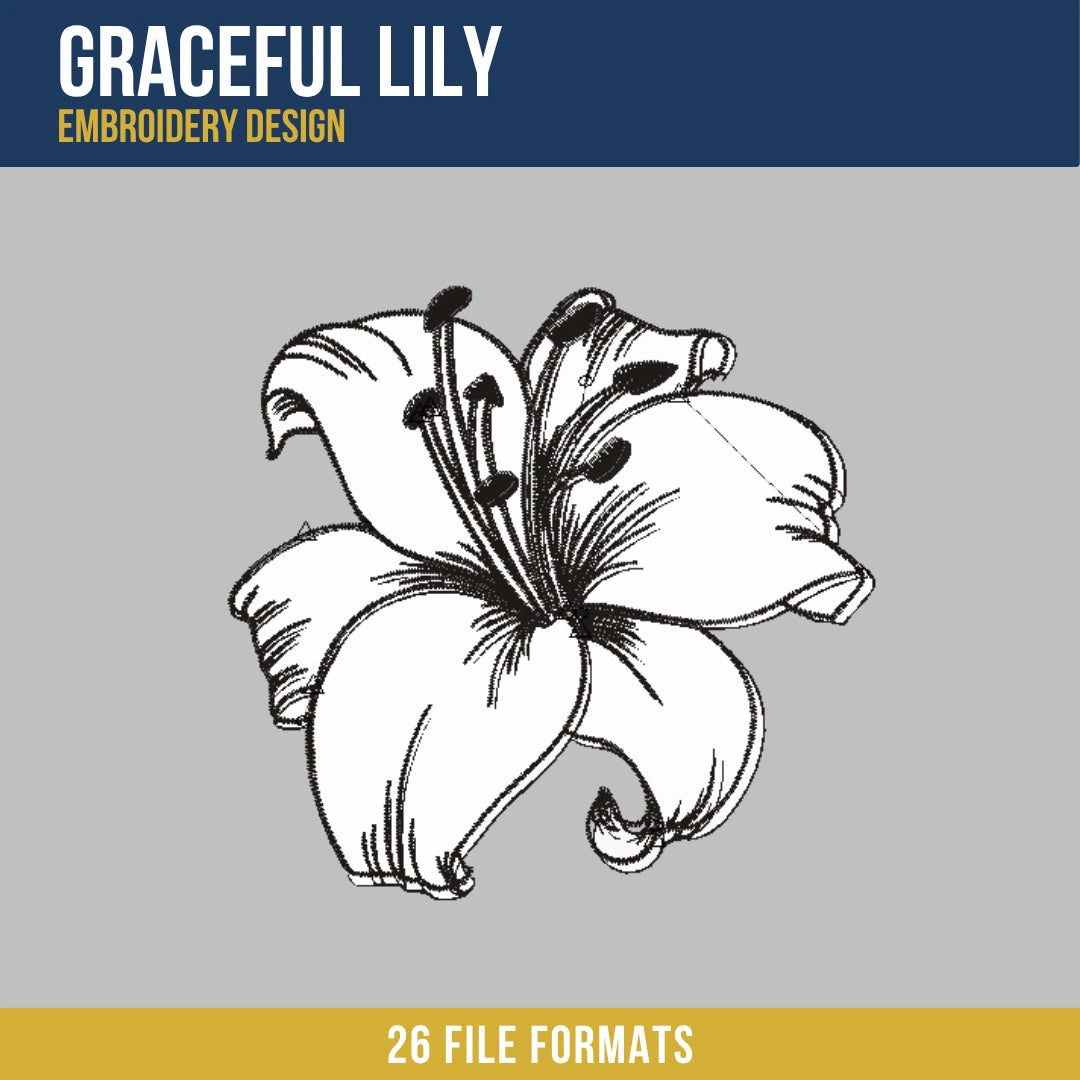
The Graceful Lily embroidery design is a single-color botanical illustration composition featuring a fully open lily bloom rendered in fine running stitch and satin outline line art, with six broad petals in open unfilled outline, a dense cluster of stamens with filled anther tips at the center, and detailed petal vein lines and curling petal edge detail worked in dark charcoal thread on an otherwise unstitched white fabric background. The design captures the graceful structure of a mature lily bloom in the style of a botanical engraving, using line weight variation and internal detail lines to convey form and depth without any fill stitching. Total stitch count is 9,005 stitches.
What distinguishes this design from other floral line art embroidery files in a botanical collection is the stamen cluster as a primary detail element. Most floral outline designs treat the center of the bloom as a minimal accent area. In this composition, the stamen cluster is the most detail-dense zone of the entire design, with multiple individual filament lines rising from the flower center and each terminating in a small filled oval anther, requiring the digitizing to resolve fine parallel line elements and small dense fill accents simultaneously at the center of an otherwise open unfilled composition.
Design Details
The lily bloom is depicted in a three-quarter view with the flower face angled slightly toward the viewer. Six petals are arranged around the central stamen cluster, each petal outlined as a broad curved shape with a running stitch perimeter line and two or three internal vein lines running from the petal base toward the tip. The petal edges on several petals show a slight curling or reflexing detail at the tips, rendered as small curved outline strokes that suggest the natural recurving of mature lily petals. Two petals at the rear of the bloom are partially obscured by the front petals and rendered as partial outlines behind the main petal layer.
At the center of the bloom, eight to ten stamen filaments rise from the flower throat as individual fine running stitch lines. Each filament curves slightly as it rises, and at the top of each filament, a small oval or club-shaped anther is rendered as a compact filled satin stitch element in dark charcoal, creating the only filled areas in the otherwise line-only composition. The flower throat at the base of the stamens is suggested by a cluster of short radiating lines and a slightly denser stitch concentration at the center origin point. The overall composition reads as a high-quality botanical line illustration translated faithfully into embroidery stitch paths.
Size Guide
| Size | Dimensions | Stitch Count |
|---|---|---|
| 4 inch | 4.03 x 3.82 in | 9,005 |
Formats Included
- PES, PEC — Brother, Baby Lock, Bernina
- DST, DSB — Tajima
- JEF, SEW — Janome, Elna
- VP3, VIP, SHV, HUS — Husqvarna Viking
- PCS, PCQ, PCD — Pfaff
- XXX — Singer
- ART — Bernina software
- 000 — Singer/generic
- 100 — Toyota
- CND — Melco/Conde
- CSD — Singer/POEM
- DGT — Barudan
- DSZ — Tajima older
- EMD — Elna
- EXP — Melco/Bernina
- INF — design info
Digitizing Quality
The primary technical challenge in this design is managing the stamen filament cluster at the flower center, where multiple fine running stitch lines originate from a very small area and radiate outward in slightly different directions. In a line-only design, all thread travel between elements must be carefully managed to avoid visible jump stitches on the fabric surface, and a radial cluster of this density has numerous potential travel paths between individual filaments. The filaments are digitized in a continuous path sequence that moves from one filament to the adjacent one with minimal backtracking, reducing the number of thread jumps in the most visually exposed area of the composition.
The small filled anther shapes at the tip of each stamen filament are the only satin fill elements in an otherwise entirely line-based design. Transitioning cleanly between the fine running stitch filament lines and the compact satin fill anthers requires each filament path to terminate precisely at the base of its anther fill so there is no gap or overlap between the line end and the fill boundary. At the scale of these anther elements, even a fraction of a millimeter of misalignment between the filament termination and the anther fill origin would be visible as a disconnected or doubled stitch at the filament-anther junction.
The petal vein lines within each petal outline require precise path placement so they read as internal anatomical detail rather than random lines. Each vein line must originate convincingly from the petal base and travel toward the petal tip at an angle consistent with the petal's curvature, narrowing or fading as it approaches the tip. The vein paths are individually positioned for each petal based on its specific shape and orientation in the three-quarter view composition, rather than being copied from a standardized vein template applied uniformly across all petals.
License
This design is licensed for personal use and small commercial production of finished physical goods. You may sell embroidered items created with this file. The digital files themselves may not be resold, redistributed, shared, or included in any digital product collection.
Instant Download
Files are available immediately after purchase with no waiting and no shipping. This listing includes 1 size in 26 embroidery formats. Complete your purchase and download your full file package directly from your order confirmation.