Bundzy
Honeybee Harmony Embroidery Design
Honeybee Harmony Embroidery Design
Couldn't load pickup availability
Honeybee Harmony Embroidery Design: Honeybee and Honeycomb Machine Embroidery File
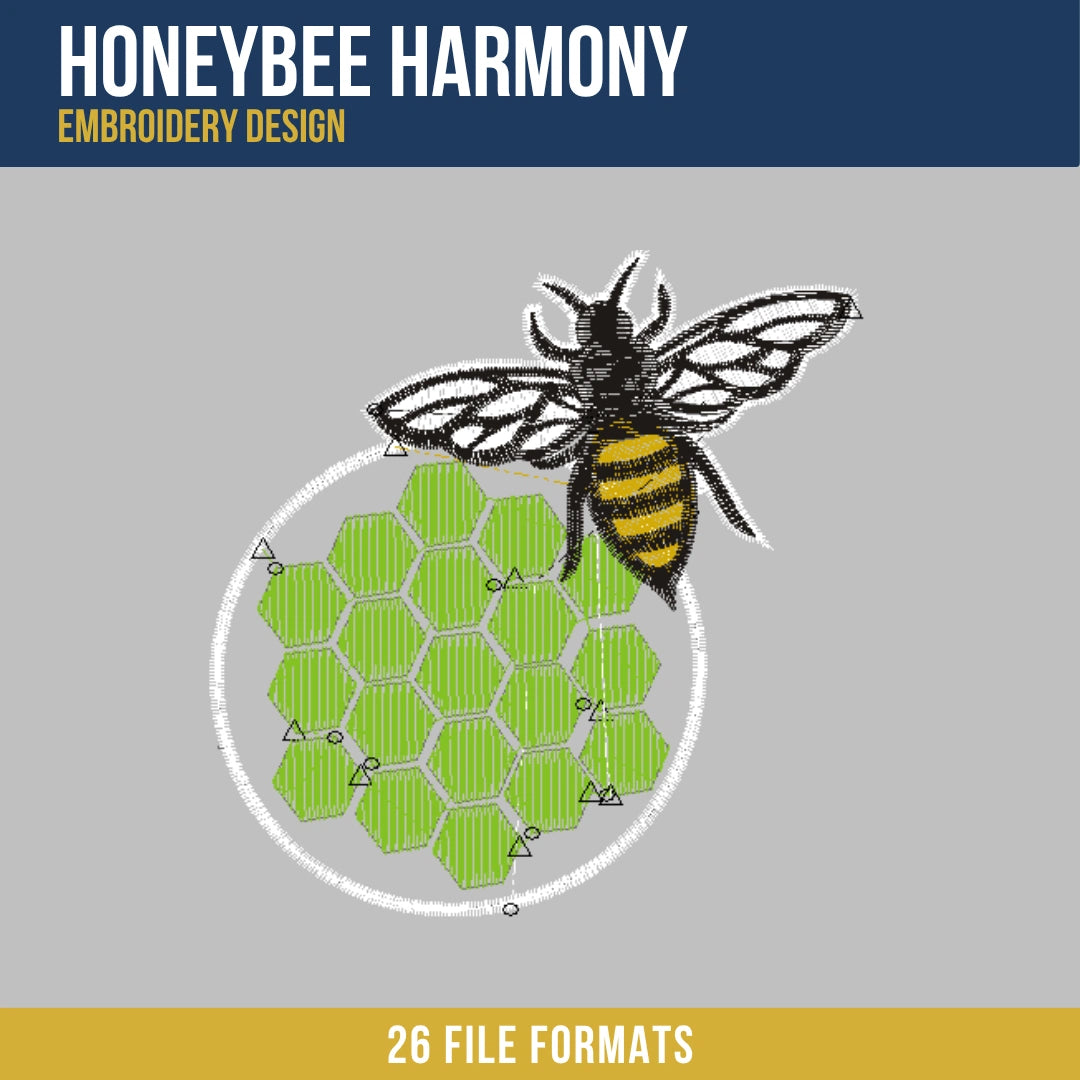
The Honeybee Harmony embroidery design is a multicolor nature emblem composition featuring a detailed honeybee rendered in black and golden yellow overlapping a circular white outline ring that frames a grid of bright green filled honeycomb hexagons below. The bee is constructed with a dense black body fill, alternating yellow and black abdominal stripe fills, and two pairs of wings built from black outline framework with white or light grey fill panels suggesting translucent wing membrane. The honeycomb grid inside the circle consists of individual hexagon fills separated by unstitched gaps, creating the open lattice structure of a natural comb section. Total stitch count is 9,439 stitches.
What distinguishes this design from other bee or insect embroidery files in a nature collection is the compositional overlap between the bee subject and the circular frame element. The bee body and wings extend above and across the top of the white circle ring, with the bee's lower abdomen descending into the circle interior over the honeycomb grid. This overlap requires the circle outline, the honeycomb fills, and the bee fills to be sequenced in three distinct depth layers so the bee reads as sitting in front of both the circle frame and the honeycomb background, while the circle frame reads as sitting in front of the honeycomb grid behind it.
Design Details
The white circle outline ring is a clean satin stitch circle that forms the frame boundary of the composition. Inside the circle, the honeycomb background is built from a regular grid of bright lime-green hexagon fills, each hexagon individually filled with a directional satin stitch and separated from its neighbors by narrow unstitched gap channels that define the cell walls. The hexagons are arranged in the offset row pattern of natural honeycomb, with the outermost cells partially cropped by the circular frame boundary.
The honeybee is positioned at the upper center of the composition with its head above the circle ring and its body descending into the circle interior. The head and thorax are filled in dense black satin stitch. The abdomen is built from alternating horizontal band fills in bright golden yellow and black, creating the characteristic bee stripe pattern. Six legs extend from the thorax-abdomen junction as fine black line elements. The two pairs of wings spread upward and to the sides, each wing constructed from a black satin outline framework with interior vein lines and light fill panels within the wing cells suggesting a translucent membrane. Two short antennae extend from the head with small oval tips.
Size Guide
| Size | Dimensions | Stitch Count |
|---|---|---|
| 3 inch | 3.46 x 3.57 in | 9,439 |
Formats Included
- PES, PEC — Brother, Baby Lock, Bernina
- DST, DSB — Tajima
- JEF, SEW — Janome, Elna
- VP3, VIP, SHV, HUS — Husqvarna Viking
- PCS, PCQ, PCD — Pfaff
- XXX — Singer
- ART — Bernina software
- 000 — Singer/generic
- 100 — Toyota
- CND — Melco/Conde
- CSD — Singer/POEM
- DGT — Barudan
- DSZ — Tajima older
- EMD — Elna
- EXP — Melco/Bernina
- INF — design info
Digitizing Quality
The primary technical challenge in this design is managing the three-layer depth sequence across the composition. The honeycomb hexagons stitch first as the background layer, the white circle ring stitches second as the mid-layer frame, and the bee fills stitch last as the foreground subject. Each layer transition must be clean so that no earlier layer bleeds through a later one, and the bee fills that overlap the circle ring must cover the ring's white satin stitches without creating visible stitch buildup at the overlap zones. The bee body density is calibrated to provide full coverage over the white ring without compressing the fabric at the overlap area.
The honeycomb hexagon grid requires each cell to be individually filled while maintaining consistent gap width between all adjacent cells. As with the Football Patch in this collection, the gap channels between hexagon cells are formed by unstitched fabric rather than applied outline stitches, meaning the precision of the fill boundaries determines the visual clarity of the cell walls. Each hexagon fill uses inward pull compensation so the green fills contract away from the gap channels, keeping the cell wall gaps open and uniform across the full grid. The partial hexagons at the outer edge of the grid, cropped by the circle boundary, are individually shaped to terminate cleanly at the inner edge of the circle ring.
The wing construction on the bee presents a fine-detail challenge at 3.46 inches total width. Each wing is built from a black satin outline framework with interior fill panels representing the individual cells of the wing membrane. At this scale, the wing cell fills are small enough that their internal boundaries must be simplified relative to a larger rendering, while still retaining enough structural line detail that the wings read as membranous rather than as plain filled shapes. The wing vein lines and cell fills are individually optimized to hold their form without over-stitching the compact wing area.
License
This design is licensed for personal use and small commercial production of finished physical goods. You may sell embroidered items created with this file. The digital files themselves may not be resold, redistributed, shared, or included in any digital product collection.
Instant Download
Files are available immediately after purchase with no waiting and no shipping. This listing includes 1 size in 26 embroidery formats. Complete your purchase and download your full file package directly from your order confirmation.