Bundzy
Japanese Koi Fish Embroidery Design
Japanese Koi Fish Embroidery Design
Couldn't load pickup availability
Japanese Koi Fish Embroidery Design: Japanese Koi Fish Machine Embroidery File
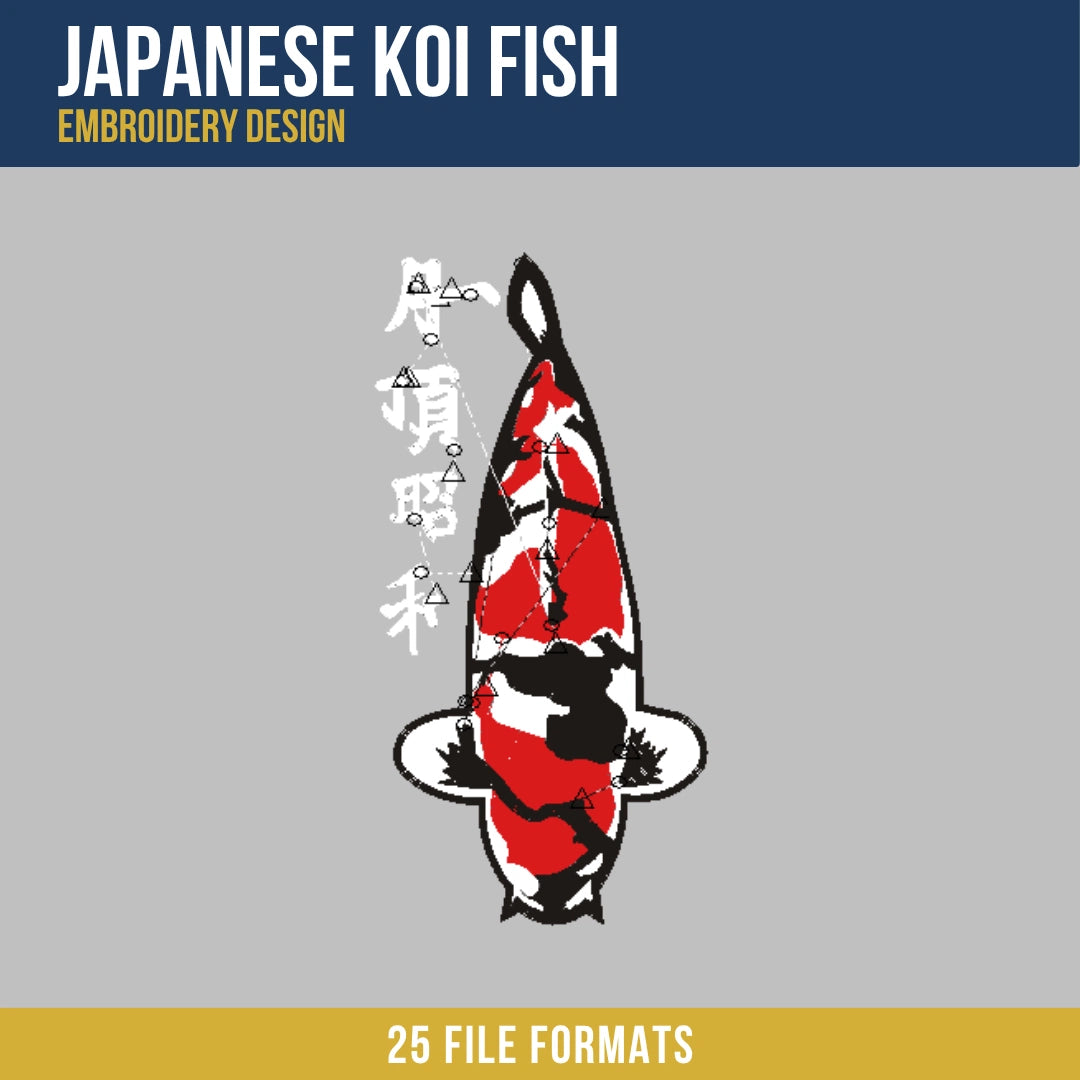
The Japanese Koi Fish embroidery design is a bold top-view koi composition rendered in a traditional Japanese illustration style, featuring a single koi fish viewed from directly above with its body filled in a high-contrast pattern of red, black, and white markings, outlined by a thick dark border that gives the design a graphic, patch-ready quality. The fish is accompanied by four vertical Japanese kanji characters stitched in a light grey outline to the left of the body, adding cultural authenticity and compositional balance to the design. Total stitch count is 42,662 stitches.
What distinguishes this design from other fish or aquatic embroidery files in an Asian-inspired collection is its aerial perspective combined with the irregular organic patterning of authentic koi coloration. Unlike side-profile fish designs where the body reads as a simple silhouette, the top-view orientation reveals the full dorsal surface of the koi including the pectoral fins, tail fork, and the asymmetric distribution of color patches across the body, each of which must be individually digitized as a shaped fill zone within the overall fish body outline.
Design Details
The koi body is presented in a vertical orientation, tapering from a narrow pointed head at the top to a forked tail at the bottom. The outer body silhouette is defined by a thick dark charcoal or black satin stitch border that outlines the entire fish form including the two small pectoral fins on either side of the lower body. Inside the border, the body is filled with three color zones. The base is a clean white or light grey fill covering the full body interior. Over the white base, large irregular red fills are applied in organic patch shapes that concentrate toward the upper body and mid-section. Dark black or very deep charcoal irregular patches are layered over and between the red zones, creating the tri-color patterning characteristic of Showa or Sanke koi varieties.
The tail section at the lower end of the body is filled with the same white base and carries small dark fin ray detail lines. The pectoral fins on either side are filled in the same light grey-white as the body base with minimal interior detail. To the left of the fish body, four Japanese kanji characters are arranged vertically and stitched in a light silver-grey running stitch or light fill outline, sized proportionally to complement the fish without competing with it visually.
Size Guide
| Size | Dimensions | Stitch Count |
|---|---|---|
| 5 inch | 5.17 x 10.46 in | 42,662 |
Formats Included
- PES, PEC — Brother, Baby Lock, Bernina
- DST, DSB — Tajima
- JEF, SEW — Janome, Elna
- VP3, VIP, SHV, HUS — Husqvarna Viking
- PCS, PCQ, PCD — Pfaff
- XXX — Singer
- ART — Bernina software
- 000 — Singer/generic
- 100 — Toyota
- CND — Melco/Conde
- CSD — Singer/POEM
- DGT — Barudan
- DSZ — Tajima older
- EMD — Elna
- EXP — Melco/Bernina
- INF — design info
Digitizing Quality
The primary technical challenge in this design is managing the layered color patch structure of the koi body without stitch buildup at the zones where red and black patches overlap the white base fill. The body requires three sequential fill passes in the same area: the white base layer, the red patch layer, and the black patch layer. Each upper layer must have its underlay and density adjusted to account for the compressed fabric beneath it, so the surface of the uppermost patches remains smooth and the total stitch density at overlap zones does not cause the fabric to stiffen or distort.
The irregular organic edges of each color patch present a further digitizing challenge. Unlike geometric fill zones with clean straight or curved boundaries, the koi patch shapes have complex freeform outlines that require careful node placement to stitch cleanly without jagged edges or visible stitch stepping at the boundaries between color zones. The boundary between each red and black patch must read as a smooth organic edge on fabric, which requires pull compensation to be set individually for each patch shape based on its orientation and the direction of the fill stitches within it.
The kanji characters to the left of the fish body required a separate approach from the main fish fills. The characters are small relative to the overall design height and are rendered in a light outline style, meaning the stitch path must be precise enough to preserve the structural strokes of each character at reduced scale without the characters becoming illegible or losing their form on fabric.
License
This design is licensed for personal use and small commercial production of finished physical goods. You may sell embroidered items created with this file. The digital files themselves may not be resold, redistributed, shared, or included in any digital product collection.
Instant Download
Files are available immediately after purchase with no waiting and no shipping. This listing includes 1 size in 25 embroidery formats. Complete your purchase and download your full file package directly from your order confirmation.