Bundzy
Japanese Love Kanji (Ai) Embroidery Design
Japanese Love Kanji (Ai) Embroidery Design
Couldn't load pickup availability
Japanese Love Kanji (Ai) Embroidery Design: Japanese Kanji Character Machine Embroidery File
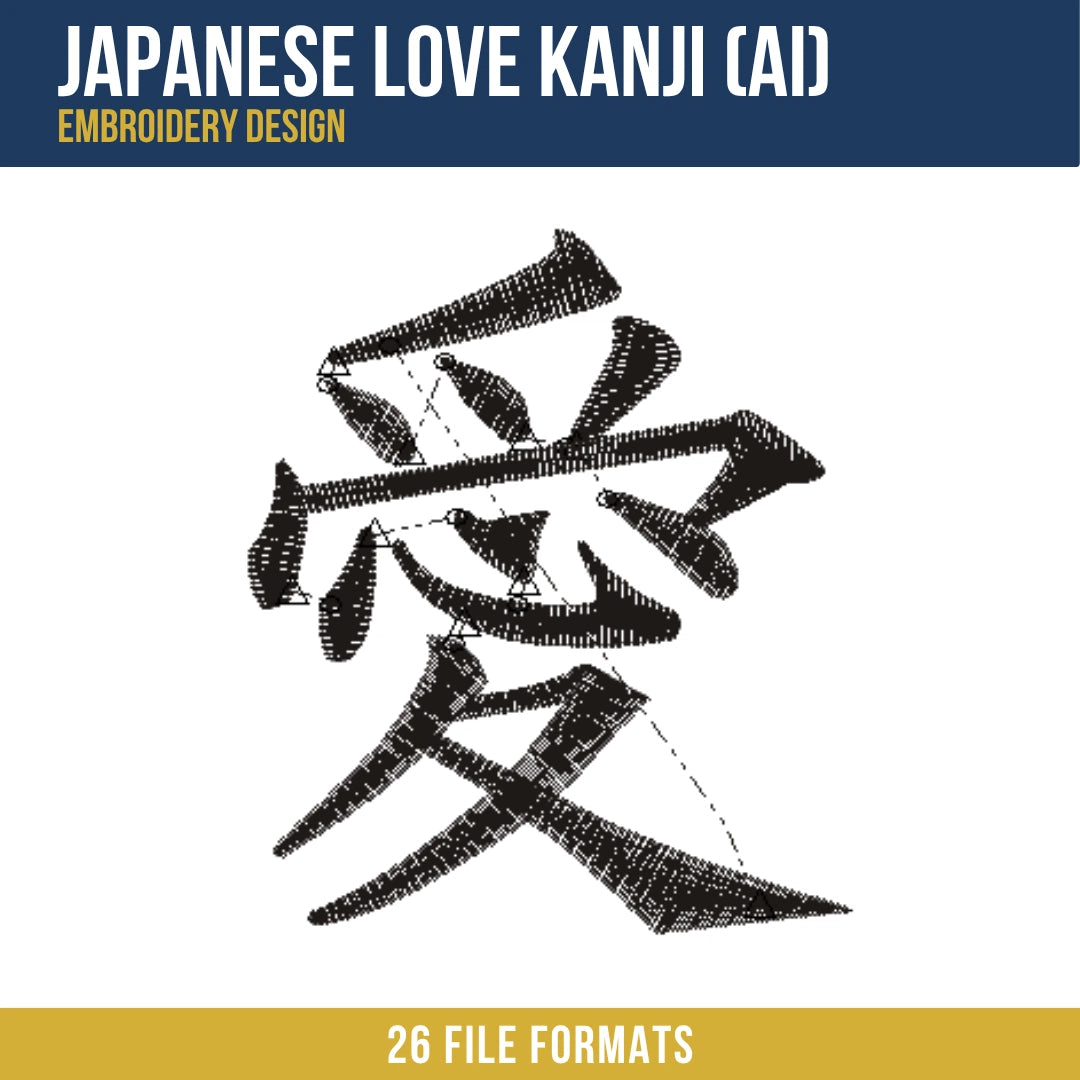
The Japanese Love Kanji (Ai) embroidery design is a single-color calligraphic character composition featuring the kanji 愛 (Ai, meaning love) rendered in dark charcoal-brown satin fill stitching that replicates the brush stroke weight variation of traditional Japanese calligraphy, with thick primary strokes tapering to fine pointed terminals and small secondary stroke elements distributed across the character structure. The design captures the visual complexity of this multi-stroke kanji in a clean single-color fill format suitable for garments, accessories, and cultural embroidery projects. Total stitch count is 2,664 stitches.
What distinguishes this design from other kanji or Asian script embroidery files in a Japanese collection is the structural complexity of the Ai character itself relative to its compact stitch count. The kanji 愛 is one of the more stroke-complex single characters in common use, comprising multiple horizontal, vertical, diagonal, and curved stroke components arranged in three visual tiers. Resolving the full stroke structure of this character with accurate brush weight variation at under 2,664 stitches requires significant path optimization to maintain stroke legibility without inflating the stitch count beyond what the character proportions can support.
Design Details
The kanji 愛 is structured in three vertical tiers that stack from top to bottom. The upper tier contains the roof radical component, rendered as a broad inverted V stroke with a small dot element above it, the strokes tapering to sharp points at their lower terminals. The middle tier contains the heart radical component, the most visually complex section, built from a horizontal stroke crossing the character width, flanked by small angled stroke elements on both sides and a central downward stroke below the horizontal, with additional small secondary strokes creating the characteristic open structure of the heart radical. The lower tier contains the broad sweeping friend radical component, rendered as two large diagonal stroke fills that cross each other at the lower center of the character and extend outward to lower left and lower right terminal points, creating the wide spreading base that anchors the full kanji form.
Throughout the character, each stroke is individually filled with a directional satin stitch angle aligned to the dominant stroke direction, with stroke width varying from broad at the main body of each stroke to fine at the pointed terminals, replicating the brush pressure variation of traditional calligraphic execution. The overall character reads as a single unified calligraphic form rather than as a collection of separate geometric fills.
Size Guide
| Size | Dimensions | Stitch Count |
|---|---|---|
| 2 inch | 2.32 x 2.71 in | 2,664 |
Formats Included
This design is delivered in 26 file formats compatible with all major embroidery machine brands: PES, PEC (Brother, Baby Lock, Bernina); DST, DSB (Tajima); JEF, SEW (Janome, Elna); VP3, VIP, SHV, HUS (Husqvarna Viking); PCS, PCQ, PCD (Pfaff); XXX (Singer); ART (Bernina software); 000 (Singer/generic); 100 (Toyota); CND (Melco/Conde); CSD (Singer/POEM); DGT (Barudan); DSZ (Tajima older); EMD (Elna); EXP (Melco/Bernina); INF (design info).
Digitizing Quality
The primary technical challenge in this design is replicating the brush stroke taper variation of traditional calligraphy using satin fill stitching at under 2.4 inches total width. Each stroke of the kanji must widen convincingly through its body and narrow to a fine point at its terminal without the tip blunting or the taper appearing mechanical. At this compact size, the individual stroke fills are narrow enough that the taper geometry at each terminal must be precisely controlled through individual stitch path shaping rather than relying on standard fill boundary behavior, which tends to round rather than sharpen at small-scale terminations.
The intersection zones within the middle tier heart radical, where multiple short strokes converge in a small area, are the highest density region of the character. Several stroke fills terminate near each other within a compact zone, and the combined stitch density from all converging stroke ends can cause the fabric to stiffen or dimple at this point if not managed. The stroke terminations in the heart radical convergence zone are individually shortened and their underlays reduced to distribute density evenly rather than stacking it at a single intersection point.
The two large diagonal stroke fills in the lower tier that cross each other at the character base required careful sequencing to establish which stroke passes in front of the other at the crossing point. In traditional calligraphy, the stroke execution order is defined by convention and determines which stroke visually overlaps the other. The crossing is digitized to reflect the conventional stroke order of the kanji, with the correct stroke stitching last to sit visually on top at the intersection, preserving the calligraphic authenticity of the character on fabric.
License
This design is licensed for personal use and small commercial production of finished physical goods. You may sell embroidered items created with this file. The digital files themselves may not be resold, redistributed, shared, or included in any digital product collection.
Instant Download
Files are available immediately after purchase with no waiting and no shipping. This listing includes 1 size in 26 embroidery formats. Complete your purchase and download your full file package directly from your order confirmation.