Bundzy
Minimalist Feather Accent Embroidery Design
Minimalist Feather Accent Embroidery Design
Couldn't load pickup availability
Minimalist Feather Accent Embroidery Design: Small Feather Machine Embroidery File
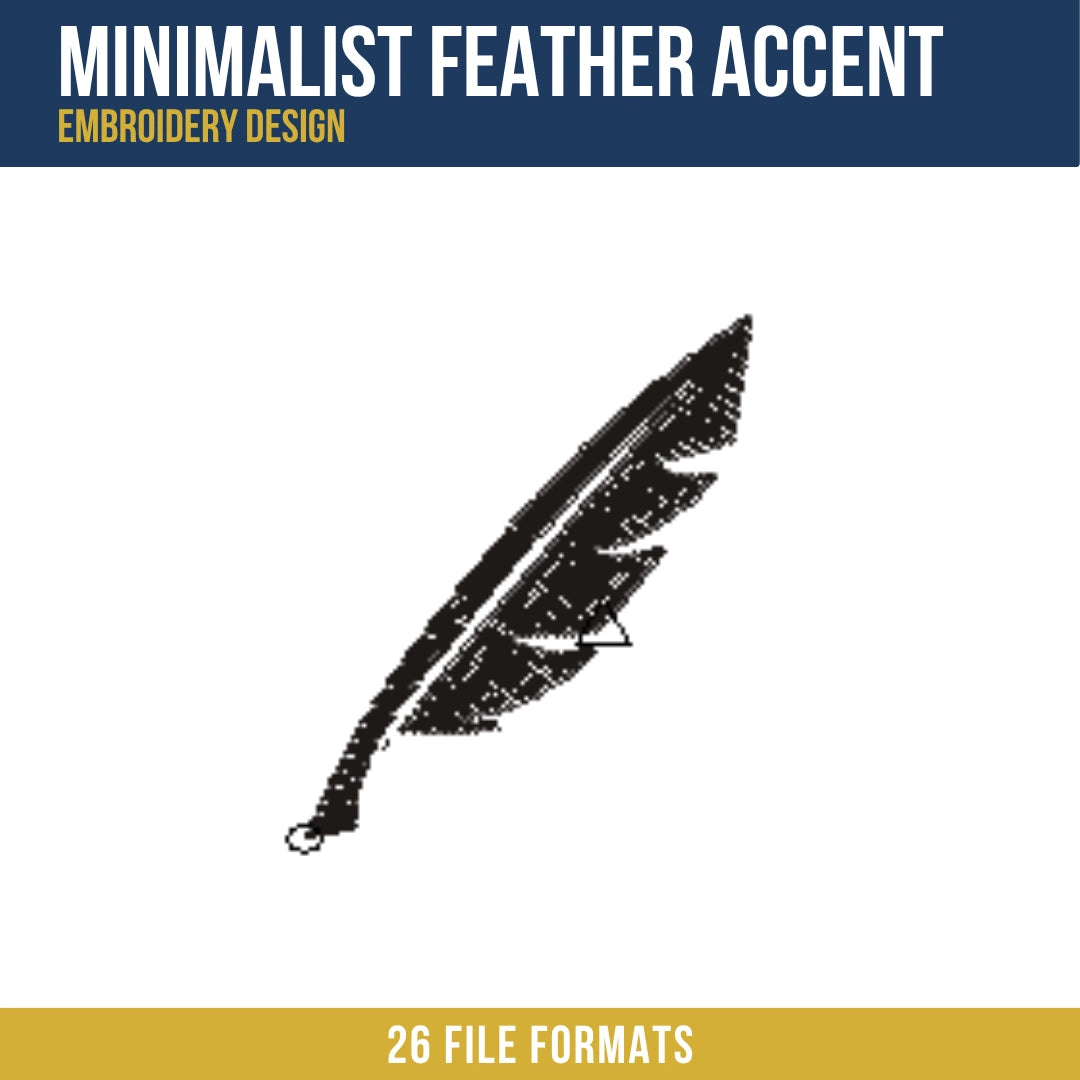
This Minimalist Feather Accent embroidery design is a compact, graphic machine embroidery file featuring a single diagonal feather rendered entirely in dark charcoal thread. The feather is constructed from a central quill satin line with two mirrored vane fills flanking it, each vane subdivided by open void gaps that suggest separated barb groups giving the feather its characteristic split appearance. The overall silhouette is a slim diagonal form tapering from a pointed tip at the upper right to a narrow quill base at the lower left. Total stitch count is 683 stitches.
What distinguishes this design from every other design in this collection is its extreme economy. At 683 stitches across a 1.02 x 1.19 inch footprint, this is the smallest and most stitch-efficient file in the collection. Where other designs use density and layering to build detail, this feather relies entirely on void space and minimal fill to convey form. The open gaps between the barb groups must read as intentional separations rather than stitch failures, which demands more precise path planning per stitch than any higher-count design in the collection requires.
Design Details
The central quill runs diagonally from lower-left to upper-right as a narrow satin column that defines the spine of the feather. The column is slightly wider at the base and tapers toward the tip, suggesting the natural taper of a quill shaft. The vane on each side of the quill is divided into three distinct barb group sections separated by open void cuts that angle diagonally away from the quill, replicating the appearance of separated feather barbs. Each barb group section is filled with a short directional satin fill running perpendicular to the quill axis. The upper tip of the feather forms a solid filled point where the vane sections converge without a void gap, giving the tip its sharp graphic quality. The lower quill base narrows to a fine satin taper. No separate outline border is used anywhere in the design; the feather silhouette is defined entirely by the fill edges and the void gaps between barb sections, giving the design its clean, sketch-like minimalist character.
Size Guide
| Size | Dimensions | Stitch Count |
|---|---|---|
| Standard | 1.02 x 1.19 in | 683 |
Formats Included
- PES, PEC - Brother, Baby Lock, Bernina
- DST, DSB - Tajima
- JEF, SEW - Janome, Elna
- VP3, VIP, SHV, HUS - Husqvarna Viking
- PCS, PCQ, PCD - Pfaff
- XXX - Singer
- ART - Bernina software
- 000 - Singer/generic
- 100 - Toyota
- CND - Melco/Conde
- CSD - Singer/POEM
- DGT - Barudan
- DSZ - Tajima older
- EMD - Elna
- EXP - Melco/Bernina
- INF - design info
Digitizing Quality
The primary challenge in this design is making the void gap cuts between barb groups read as clean, intentional separations rather than missed stitches. At only 1.02 x 1.19 inches, each gap is only a fraction of a millimeter wide, and if the fill sections on either side of a gap are not precisely terminated and restarted at the correct point, the gap either closes up or widens unevenly on the finished piece. Each barb group fill was individually mapped with its start and end points set to produce a consistent gap width across all three separations on both vane sides.
The quill satin column requires a controlled taper across its full diagonal length. Because this is a single-color design with no outline border, the quill edge is the only boundary between the filled shaft and the open ground fabric. Any deviation in column width along the taper path is immediately visible as an uneven quill edge. The column was digitized with manual width control at each node point along the diagonal path, stepping the width down gradually from base to tip rather than relying on automatic taper interpolation.
At 683 stitches, travel path efficiency between the quill and each barb group section is critical. With so few stitches in the design, even a single unnecessary jump stitch represents a meaningful proportion of the total stitch run. The sequence was planned so the machine completes the quill column first, then travels directly into each barb group in order from tip to base along one vane, then crosses at the quill base and works back up the opposite vane, producing the minimum possible number of jump stitches across the full design.
License
This design is licensed for commercial use on finished physical goods. You may sell embroidered items made with this file without per-item royalty. Digital files, including all included formats, may not be resold, redistributed, or shared in any form, whether modified or unmodified.
Instant Download
Files are available immediately after purchase. This listing includes 1 size in 26 file formats, covering every major home and commercial embroidery machine brand. Download, unzip, and load directly into your machine or embroidery software.