Bundzy
Monogram Border Embroidery Design
Monogram Border Embroidery Design
Couldn't load pickup availability
Monogram Border Embroidery Design: Three-Letter Monogram Frame Machine Embroidery File
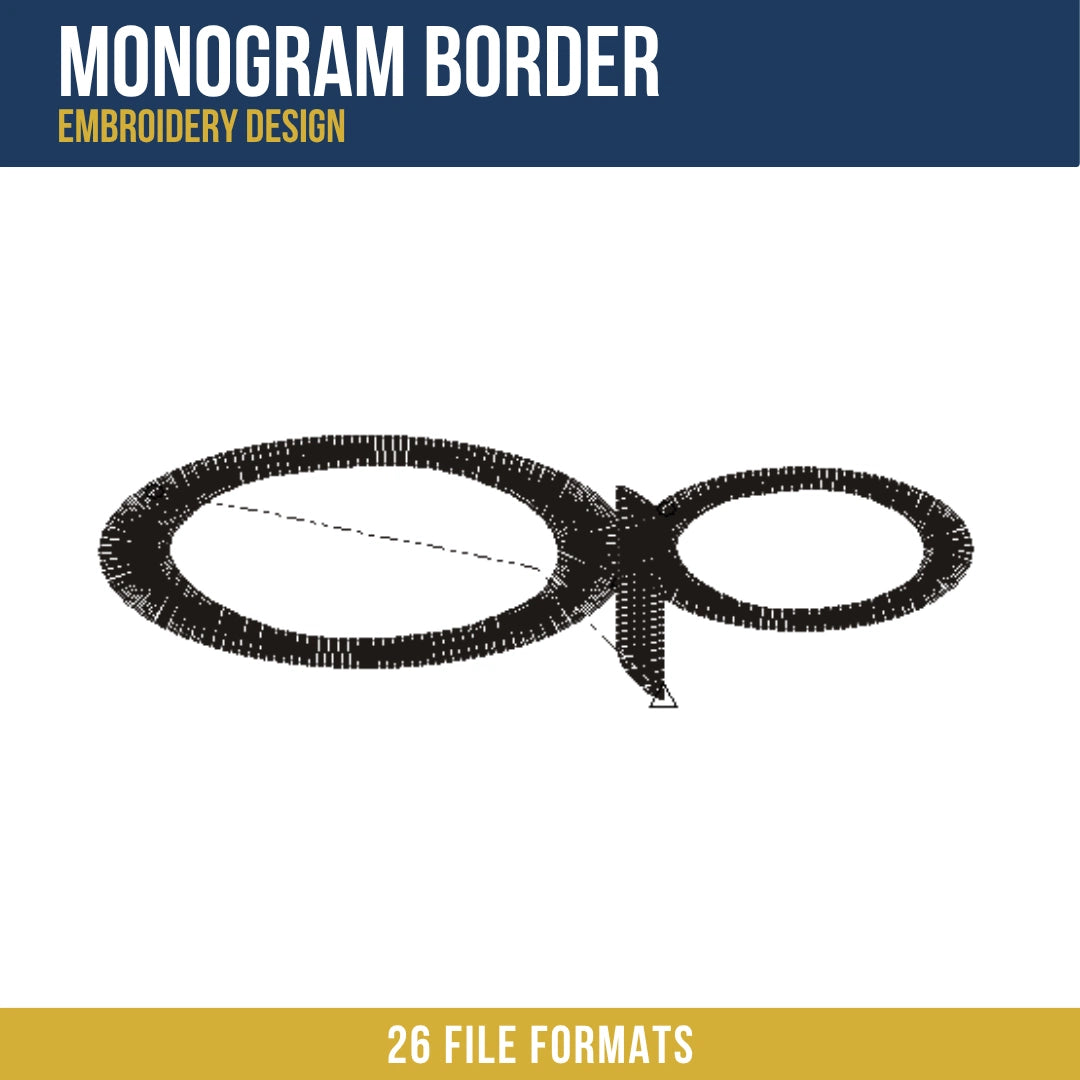
This Monogram Border embroidery design is a clean, elegant machine embroidery file featuring a classic three-letter monogram frame composed of two oval rings flanking a central vertical bar element, all rendered in dark charcoal thread. The left oval is larger, representing the frame for the center initial, while the right oval is smaller, framing a secondary initial. The central connecting piece is a narrow vertical satin bar with a small pointed finial at the base. The entire design is constructed from satin column fills with fully open interiors, ready to receive digitized or machine-stitched initials. Total stitch count is 1,912 stitches.
What distinguishes this design from the Baroque Floral Frame and Minimalist Leaf Wreath Frame in this collection is that this frame is a pure geometric construction with no organic or botanical elements. Both ovals are closed forms built entirely from constant-radius satin arcs, making consistent satin column width around the full circumference of each ring the sole quality criterion. There is no taper variation, no directional fill, and no detail line work anywhere in the design; every stitch must serve the clean oval geometry.
Design Details
The left oval is the dominant element, occupying roughly two-thirds of the total design width. It is rendered as a closed elliptical satin ring with consistent column width around its full perimeter. The interior of the oval is fully open, providing a clear placement zone for the center initial. The right oval sits to the right of center and is notably smaller, rendered with the same satin ring construction but at a reduced scale suitable for a secondary initial. The two ovals are connected at their shared center point by a short vertical satin bar that bridges the gap between the inner edges of both rings. This central bar carries a small downward-pointing triangular finial at its base, adding a subtle decorative accent at the junction. The top of the central bar meets the inner edges of both ovals cleanly without a separate decorative element, giving the upper junction a minimal, architectural character. All elements stitch in a single dark charcoal thread with no color stops.
Size Guide
| Size | Dimensions | Stitch Count |
|---|---|---|
| Standard | 3.97 x 1.19 in | 1,912 |
Formats Included
- PES, PEC - Brother, Baby Lock, Bernina
- DST, DSB - Tajima
- JEF, SEW - Janome, Elna
- VP3, VIP, SHV, HUS - Husqvarna Viking
- PCS, PCQ, PCD - Pfaff
- XXX - Singer
- ART - Bernina software
- 000 - Singer/generic
- 100 - Toyota
- CND - Melco/Conde
- CSD - Singer/POEM
- DGT - Barudan
- DSZ - Tajima older
- EMD - Elna
- EXP - Melco/Bernina
- INF - design info
Digitizing Quality
The defining challenge in this design is maintaining perfectly consistent satin column width around the full circumference of each oval. Unlike a straight satin border, an elliptical ring requires the stitch columns to stay perpendicular to the curve centerline at every point around the arc. Any angular inconsistency as the path rounds the narrow ends of the ellipse produces a visible narrowing or fanning of the border that breaks the clean geometric reading of the ring. Both ovals were digitized with manual node control at closely spaced intervals around their full perimeters, particularly at the high-curvature ends where the perpendicular angle changes most rapidly.
The size difference between the two ovals creates a specific consistency requirement. Because the smaller right oval has tighter curvature at its ends than the larger left oval, the same column width setting produces a more compressed stitch angle at the smaller oval's narrow ends. The column width was adjusted slightly between the two ovals so that the satin surface appears visually equivalent in weight across both rings on the finished piece, even though they are different sizes.
The central vertical bar and its downward finial required precise alignment with the inner edges of both oval rings at their junction points. Any misalignment where the bar meets an oval edge produces a visible gap or overlap that disrupts the clean connected geometry of the frame. The bar endpoints were set to overlap the oval inner edges by a controlled amount so that the junction reads as a clean continuous connection rather than a floating bar placed between two separate rings.
License
This design is licensed for commercial use on finished physical goods. You may sell embroidered items made with this file without per-item royalty. Digital files, including all included formats, may not be resold, redistributed, or shared in any form, whether modified or unmodified.
Instant Download
Files are available immediately after purchase. This listing includes 1 size in 26 file formats, covering every major home and commercial embroidery machine brand. Download, unzip, and load directly into your machine or embroidery software.