Bundzy
Nature Vine Floral Border Embroidery Design
Nature Vine Floral Border Embroidery Design
Couldn't load pickup availability
Nature Vine Floral Border Embroidery Design: Floral Crest Frame Machine Embroidery File
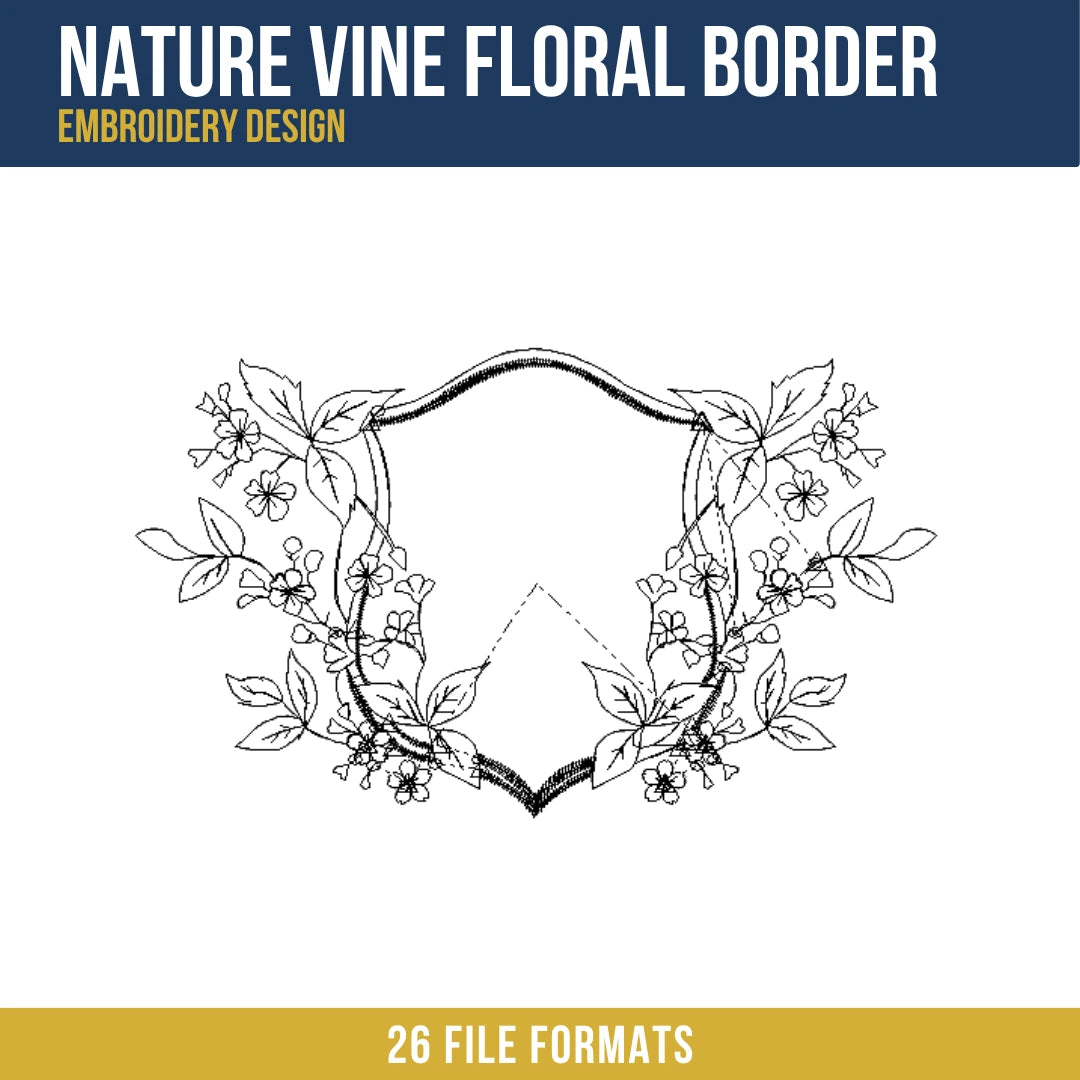
This Nature Vine Floral Border embroidery design is a delicate, redwork-style machine embroidery file featuring a heraldic crest shield frame overgrown with symmetrical floral vines, rendered entirely in dark charcoal thread as fine run-stitch and satin outline lines with no filled areas. The shield frame forms the inner boundary of the composition, while sprawling vines loaded with open five-petal blossoms, broad pointed leaves, and small berry clusters extend outward from both sides in a lush mirrored arrangement. Total stitch count is 8,853 stitches.
What distinguishes this design from every other frame and border design in this collection is its redwork construction approach. The Baroque Floral Frame, Minimalist Leaf Wreath, and Monogram Border are all built from satin fill columns; this design is built almost entirely from run-stitch outline paths with no fill stitching anywhere in the botanical elements. All leaf, flower, and vine forms are line drawings rendered in thread, not filled shapes. This demands a fundamentally different sequencing discipline where path continuity and travel efficiency determine output quality rather than fill density and layer management.
Design Details
The shield frame is the structural center of the composition, formed by two parallel satin lines that trace the heraldic crest silhouette: a curved upper arch tapering to angled side edges and converging at a pointed lower chevron. The shield interior is fully open, providing a clear monogram or text placement field. From the upper corners and mid-sides of the shield, two symmetrical vine systems extend outward. Each vine system originates as a primary stem that branches repeatedly into secondary and tertiary shoots. Along each vine branch, broad pointed leaves are rendered as outline ellipses with a single central vein run-stitch line. Open five-petal blossoms appear at multiple branch terminals, each flower rendered as five individual petal outline loops radiating from a central dot stitch. Small berry cluster accents consisting of two or three circular outline dots grouped on short stems appear between leaf and flower elements along the vine length. The outer extent of each vine spray reaches beyond the shield border at the sides and lower corners, with trailing leaf tips and flower heads extending to the outer edges of the 4.73 x 2.75 inch footprint. The two vine systems are precise mirror images across the vertical center axis of the shield.
Size Guide
| Size | Dimensions | Stitch Count |
|---|---|---|
| Standard | 4.73 x 2.75 in | 8,853 |
Formats Included
This design is delivered in 26 file formats compatible with all major machine brands: PES, PEC (Brother, Baby Lock, Bernina) | DST, DSB (Tajima) | JEF, SEW (Janome, Elna) | VP3, VIP, SHV, HUS (Husqvarna Viking) | PCS, PCQ, PCD (Pfaff) | XXX (Singer) | ART (Bernina software) | 000 (Singer/generic) | 100 (Toyota) | CND (Melco/Conde) | CSD (Singer/POEM) | DGT (Barudan) | DSZ (Tajima older) | EMD (Elna) | EXP (Melco/Bernina) | INF (design info)
Digitizing Quality
The primary challenge in a redwork design of this element count is minimizing jump stitches across the full botanical network without compromising path continuity within individual elements. Each vine branch, leaf outline, and flower petal is a separate closed or open path, and with dozens of individual elements across both vine systems, naive sequencing would produce a jump stitch between nearly every element. The stitch path was planned as a continuous tree-walking route that travels from one branch terminal to the next via the connecting stem, stitching each leaf and flower as the path reaches them and returning along the same stem segment before branching to the next sub-element.
The five-petal flower outlines required careful loop closure at each petal. Each petal is a small rounded outline that must return to its start point cleanly to produce a closed loop. At the scale of the flowers in this design, any overshoot or undershoot at the petal join point is visible as an open gap or crossed line in the finished thread outline. Each petal path was digitized as a precise closed curve with its endpoint set to match its start point exactly, and the transition between petals within each flower was routed through the flower center dot rather than across the petal surface.
Mirror symmetry across the two vine systems is a quality requirement that compounds across the full element count. Because the left and right sides are mirror images, any leaf, flower, or branch that differs in size, angle, or outline weight from its counterpart on the opposite side is immediately apparent when the design is viewed as a whole. The two vine systems were built from a single side and mirrored with node-level verification of all corresponding elements before the file was finalized.
License
This design is licensed for commercial use on finished physical goods. You may sell embroidered items made with this file without per-item royalty. Digital files, including all included formats, may not be resold, redistributed, or shared in any form, whether modified or unmodified.
Instant Download
Files are available immediately after purchase. This listing includes 1 size in 26 file formats, covering every major home and commercial embroidery machine brand. Download, unzip, and load directly into your machine or embroidery software.