Bundzy
Puma Embroidery Design - Jumping Cat Logo 26 Formats
Puma Embroidery Design - Jumping Cat Logo 26 Formats
Couldn't load pickup availability
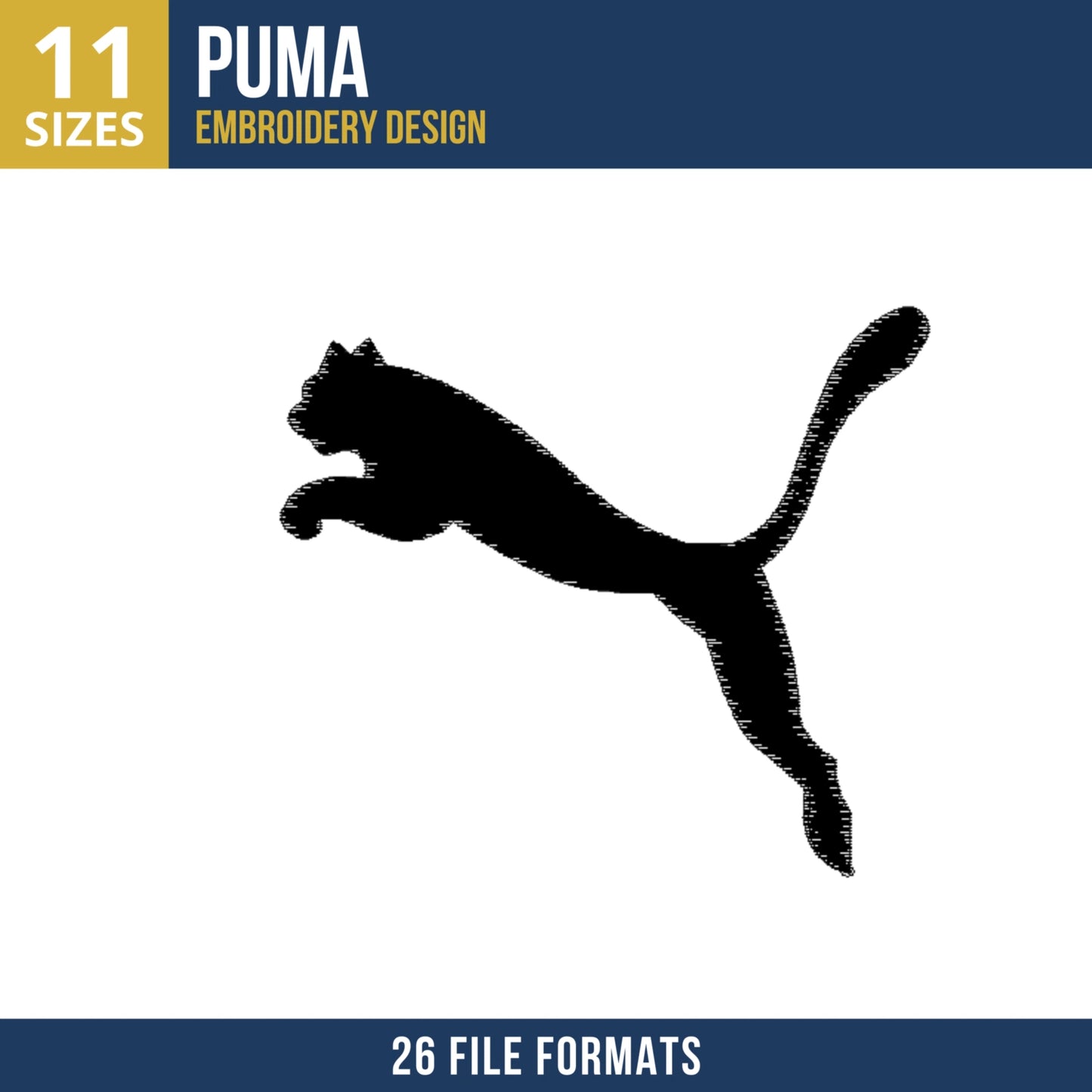
Athletic iconography capturing motion through minimalist silhouette design. The leaping cat symbol translates three-dimensional movement into two-dimensional form using negative space and dynamic angles. Eleven sizes accommodate everything from small sleeve badges to large back graphics on performance wear.
The design emphasizes speed through diagonal orientation and extended limbs. Tail curve and body arc create forward momentum even in static embroidery. This kinetic quality makes the symbol effective for sports applications where movement association enhances brand messaging.
Stitch Data Breakdown
Measurements reflect the diagonal orientation from upper right to lower left. Height and width create nearly square proportions despite the horizontal animal form.
- 7" → 6.90 x 6.01 in → 10,091 stitches
- 6.5" → 6.40 x 5.57 in → 8,787 stitches
- 6" → 5.90 x 5.14 in → 7,595 stitches
- 5.5" → 5.40 x 4.70 in → 6,465 stitches
- 5" → 4.90 x 4.26 in → 5,467 stitches
- 4.5" → 4.40 x 3.83 in → 4,528 stitches
- 4" → 3.90 x 3.39 in → 3,709 stitches
- 3.5" → 3.40 x 2.96 in → 2,964 stitches
- 3" → 2.90 x 2.52 in → 2,285 stitches
- 2.5" → 2.40 x 2.09 in → 1,703 stitches
- 2" → 1.90 x 1.65 in → 1,211 stitches
Moderate stitch counts indicate solid fill construction without excessive density. The 4-inch version completes in approximately 11-13 minutes at standard machine speeds.
Performance Apparel Context
Soccer clubs globally recognize this symbol from decades of kit sponsorships. The leaping cat appears on national team jerseys creating cultural associations between the brand and athletic achievement. Modern applications leverage this sports heritage even on non-performance garments.
Fitness centers and training facilities use this logo on staff uniforms where athletic credibility matters. The symbol communicates movement and energy appropriate for environments focused on physical activity and performance improvement.
Athleisure brands appreciate how the logo bridges athletic functionality and casual fashion. The same symbol works equally well on compression wear for actual workouts and on joggers worn for everyday errands.
Silhouette Design Principles
The cat form uses simplified anatomy focusing on recognizable features rather than realistic detail. Pointed ears, extended tail, and muscular haunches identify the animal while omitting textures and internal features that would complicate embroidery execution.
Negative space defines the design as much as filled areas. The gap between front and rear legs creates visual separation between limbs without requiring outline stitching. This approach reduces stitch count while maintaining form clarity.
Diagonal orientation from head to tail creates compositional energy. Animals positioned horizontally appear static. The angled placement suggests upward leaping motion even though the embroidery itself doesn't move.
Placement Strategy for Movement
Chest applications position the cat leaping toward the wearer's dominant shoulder, creating directional flow that complements natural body movement. Right-handed wearers get cats leaping right. This subtle orientation alignment feels more natural than centered static placement.
Sleeve positioning uses the 3-4 inch sizes where the symbol wraps slightly around arm curvature. The three-dimensional placement on cylindrical sleeve surfaces adds actual movement as arms swing during walking or running.
Back placements at 6-7 inches center the logo across shoulder blades where it reads clearly from behind. This location works particularly well for team identification in group sports where players face the same direction during play.
Technical Fill Considerations
Body fill uses angle changes that follow muscle contours of the cat form. Uniform fill angle would appear flat. Strategic angle shifts create dimensional illusion suggesting rounded torso and haunches despite two-dimensional embroidery.
Thin sections like legs and tail require adjusted stitch density to prevent thread buildup. The same density used in body areas would make narrow appendages stiff and rope-like. Reducing density in thin areas maintains flexibility while preserving coverage.
Sharp points at ears and paws need careful digitizing to avoid bird-nesting where too many stitches converge. The software must taper thread quantity as it approaches point termination preventing thread accumulation at tips.
Performance Fabric Compatibility
Moisture-wicking polyester common in activewear needs water-soluble topper preventing stitches from sinking into smooth synthetic surface. The topper dissolves after embroidery leaving clean edges without surface residue.
Stretch fabrics containing spandex require mesh cutaway backing that flexes with fabric movement. Traditional woven stabilizers restrict stretch causing embroidery to pucker during wear. Mesh backing maintains support while allowing directional give.
Compression wear's tight knit structure demands reduced tension settings to prevent fabric distortion. The dense knit resists needle penetration causing fabric to bunch rather than pierce cleanly. Loosening top tension compensates for this resistance.
Format Library
Full selection available: 000, 100, ART, BMP, CND, COL, CSD, DGT, DSB, DST, DSZ, EMD, EXP, HUS, INF, JEF, PCD, PCQ, PCS, PEC, PES, SEW, SHV, VIP, VP3, XXX.
Athletic embroidery often uses DST format for industrial equipment running team uniforms in volume. Home embroiderers select format matching their specific machine brand for optimal compatibility.
Color Versatility
Black on white creates maximum contrast for traditional athletic aesthetics. White on black inverts the relationship for dark garments common in performance wear. Navy, charcoal, and forest green offer color variation while maintaining sporty appearance.
Metallic silver or gold thread adds premium finishing suitable for championship uniforms or special edition merchandise. Metallics require 25-30% speed reduction to prevent thread breakage from extra friction through needle eye.
Gradient effects using multiple shades of the same color create dimensional appearance. Darker thread fills body areas while lighter shades highlight edges. This technique requires two-color embroidery capability but produces striking results.
Usage Rights
Apply this embroidery to physical products you manufacture and sell. Athletic wear, accessories, and promotional items constitute acceptable applications. Digital files must remain within your exclusive control and cannot be transferred to other parties.
File Access
Download begins immediately after purchase completion. Compressed archive contains all eleven sizes across all 26 formats. Extract files and transfer to embroidery equipment using standard methods appropriate for your machine model.