Bundzy
Red Chinese Dragon Embroidery Design
Red Chinese Dragon Embroidery Design
Couldn't load pickup availability
Red Chinese Dragon Embroidery Design: Traditional Chinese Dragon Machine Embroidery File
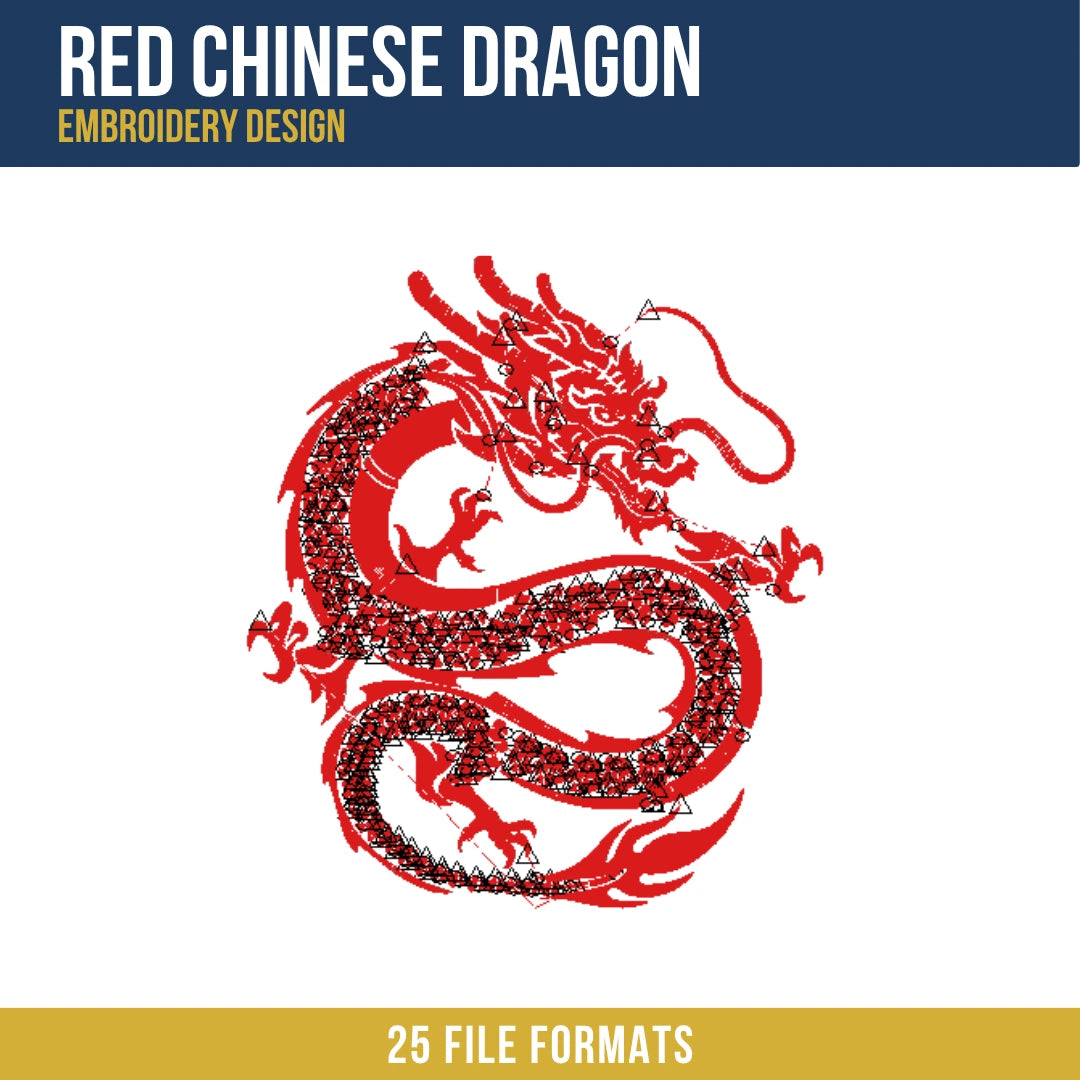
The Red Chinese Dragon embroidery design is a single-color traditional Chinese dragon composition featuring a full-body serpentine dragon coiled in a circular arrangement, rendered entirely in vivid red with a combination of dense satin fill zones and open negative space cutouts that create the illusion of a multi-tonal design using only one thread color. The dragon is built with individually scaled body segments, a detailed horned head with open mouth and whisker tendrils, four clawed feet, and a bifurcated flame tail, all constructed from directional fill stitching that follows the anatomical structure of each body section. Total stitch count is 42,717 stitches.
What distinguishes this design from other dragon embroidery files in an Asian-inspired collection is its single-color construction combined with the deliberate use of unstitched negative space within the body coils to create visual depth and separation between overlapping body sections. Unlike the Mythic Flame Dragon in this collection which uses a two-color filled-background approach, this design achieves all of its visual complexity through the shape and placement of red fill zones alone, with the white fabric showing through the interior spaces functioning as a design element rather than a background.
Design Details
The dragon body is arranged in a coiled S-curve that fills the full composition field, with the head positioned at the upper right facing left and the tail curling to the lower right. The body is divided into individual segment sections, each filled with directional satin stitches that run perpendicular to the body length to suggest the banded muscular structure of a traditional Chinese dragon form. Within each body segment, rows of overlapping scale shapes are rendered as individual curved fills with open gaps between them, creating the characteristic fish-scale patterning that runs along the full length of the coiled body.
The head is the most detail-dense area of the composition, featuring a broad open jaw with visible tooth shapes along the mouth line, a prominent brow ridge, angular eye fills, two antler-style horns curving upward from the crown, and long whisker or barbel tendrils extending from the snout. The four feet are positioned at different points along the body coil, each with three or four extended curved claw fills. Along the back ridge of the dragon, a series of small pointed spine or fin shapes add dorsal detail. The flame tail at the lower end of the body splits into two or three pointed tongue shapes filled with short directional satin stitches. Throughout the full composition, the unstitched white areas between body coils and within the scale gaps are integral to the design's visual structure.
Size Guide
| Size | Dimensions | Stitch Count |
|---|---|---|
| 9 inch | 9.67 x 10.94 in | 42,717 |
Formats Included
- PES, PEC — Brother, Baby Lock, Bernina
- DST, DSB — Tajima
- JEF, SEW — Janome, Elna
- VP3, VIP, SHV, HUS — Husqvarna Viking
- PCS, PCQ, PCD — Pfaff
- XXX — Singer
- ART — Bernina software
- 000 — Singer/generic
- 100 — Toyota
- CND — Melco/Conde
- CSD — Singer/POEM
- DGT — Barudan
- DSZ — Tajima older
- EMD — Elna
- EXP — Melco/Bernina
- INF — design info
Digitizing Quality
The primary technical challenge in this design is managing the precise boundaries of each fill zone so that the negative space gaps between scale shapes, body segments, and coil overlaps remain clean and open on fabric. In a single-color design where unstitched fabric is a structural design element, any pull or drift in the fill boundaries will encroach on the negative space and close the gaps that give the design its visual depth. Pull compensation for every fill zone must be calculated inward rather than outward so that the fills contract slightly toward their center rather than expanding into the surrounding open areas.
The individual scale shapes along the body coil are among the most repetitive fine-detail elements in the composition. Each scale is a small curved fill that must hold its shape consistently across hundreds of repetitions along the full body length. Variation in scale size, fill angle, or boundary shape between individual scales would create an uneven, irregular patterning rather than the smooth rhythmic scale texture expected from traditional Chinese dragon iconography. The scales are digitized from a standardized base shape that is adapted to the body curve angle at each position along the coil.
The overlapping body coil sections required careful sequencing to establish correct visual depth. Where one section of the dragon body passes over another, the underlying section must stitch first and the overlapping section must stitch second, with its fill edge cleanly covering the boundary of the section beneath. With a coiled composition of this complexity, establishing the correct depth order across all overlap points and sequencing the fill zones accordingly is one of the most structurally demanding aspects of the digitizing process.
License
This design is licensed for personal use and small commercial production of finished physical goods. You may sell embroidered items created with this file. The digital files themselves may not be resold, redistributed, shared, or included in any digital product collection.
Instant Download
Files are available immediately after purchase with no waiting and no shipping. This listing includes 1 size in 25 embroidery formats. Complete your purchase and download your full file package directly from your order confirmation.