Bundzy
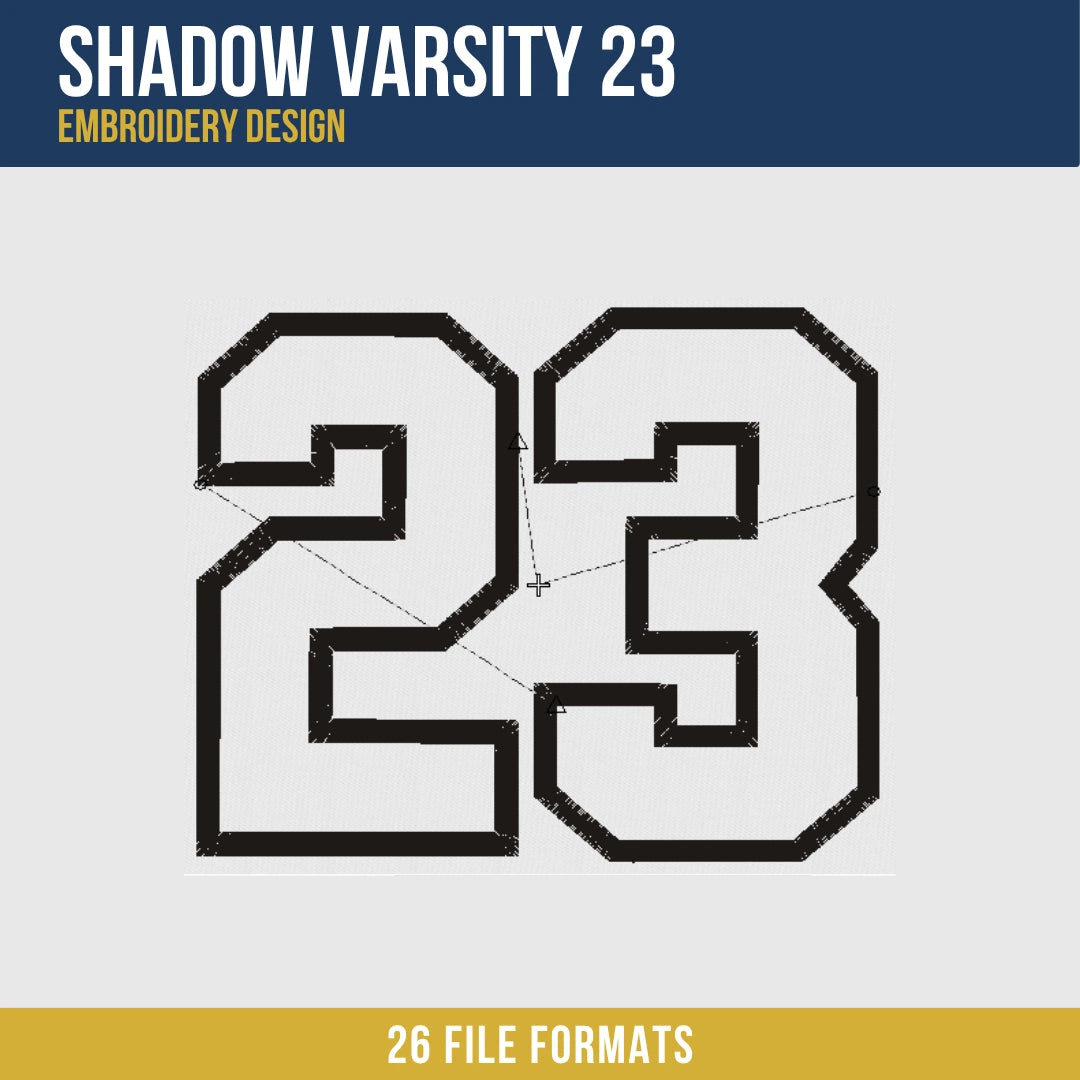
Shadow Varsity 23 Embroidery Design
Shadow Varsity 23 Embroidery Design
Couldn't load pickup availability
Shadow Varsity 21 Embroidery Design: Outline Jersey Number Machine Embroidery File
The Shadow Varsity 21 embroidery design is a large-format varsity jersey number pair rendered as pure outline construction in a single dark charcoal thread with no interior fill. The "2" is a block varsity figure with chamfered outer corners, a flat top bar, a broad upper arc transitioning into a diagonal mid-stroke, and a wide stepped base bar. The "1" is a clean upright block numeral with chamfered upper corners and a wide rectangular base. Both numerals use a dual-column satin outline that leaves all fabric fully exposed between and within the outline strokes. The design is single-color charcoal with no thread changes. Total stitch count is 15,864 stitches at 7.28 x 7.20 inches.
What makes this design technically distinct from Shadow Varsity 12, which uses the same two digit characters, is the reversed numeral order and the resulting shift in compositional balance. In Shadow Varsity 12, the simpler "1" anchors the left side and the more complex "2" finishes on the right. In Shadow Varsity 21, the "2" leads on the left at a significantly larger scale than the "1" beside it, creating a dominant-to-recessive size relationship between the two numerals that does not exist in the 12 pairing. This size disparity means the "2" carries proportionally more stitch path length and corner count than its paired numeral, and the dual-column width must be held consistent between a larger and a smaller numeral whose stroke widths are visually compared directly side by side.
Design Details
The dominant element is the large "2," which occupies the left two-thirds of the composition and is noticeably larger in overall scale than the "1" beside it. Its outer silhouette begins with a flat top bar with chamfered upper left and upper right corners, transitions through a broad convex arc on the upper right that curves leftward and downward into the diagonal mid-stroke, and terminates in a wide flat base bar with a stepped inner junction on the right side. The dual-column satin outline follows this full path with a wide outer column and a parallel inner column, the white fabric visible between them as the numeral stroke and as the open counter above the diagonal. The "1" sits to the right of the "2" at a smaller scale, its form a simple upright block with chamfered corners at the top and a wide base, rendered with the same dual-column outline construction. The "1" stroke is narrower in absolute terms than the "2" stroke but the relative satin column width is matched between both numerals so the outline weight appears consistent across the size difference. Both characters leave all interior fabric exposed, and the overall composition reads as a standard two-digit varsity jersey number pair at large placement scale suitable for chest, back yoke, or sleeve applications on athletic garments.
Size Guide
| Size | Dimensions | Stitch Count |
|---|---|---|
| Standard | 7.28 x 7.20 in | 15,864 |
Formats Included
- PES, PEC - Brother, Baby Lock, Bernina
- DST, DSB - Tajima
- JEF, SEW - Janome, Elna
- VP3, VIP, SHV, HUS - Husqvarna Viking
- PCS, PCQ, PCD - Pfaff
- XXX - Singer
- ART - Bernina software
- 000 - Singer/generic
- 100 - Toyota
- CND - Melco/Conde
- CSD - Singer/POEM
- DGT - Barudan
- DSZ - Tajima older
- EMD - Elna
- EXP - Melco/Bernina
- INF - design info
Digitizing Quality
The primary technical challenge in this design is calibrating the dual-column satin width to read as consistent between numerals of noticeably different physical size. The "2" is larger in overall scale than the "1," and a column width that looks correct on the larger numeral can appear either too heavy or too light on the smaller one when both are viewed simultaneously. The column width was set at a value that splits the visual difference between what each numeral's scale would independently suggest as optimal, verified by comparing the outline weight of both characters at the intended stitching scale rather than at digitizing zoom level.
The second challenge was the arc segment of the "2" on the larger numeral. At the expanded scale of the "2" in this pairing, the convex outer arc of the upper bowl is long enough that a fixed satin angle across the arc would produce a visible flat zone where the stitch direction no longer follows the curve of the column path. The arc was divided into angle segments at intervals calibrated to the arc radius of this specific numeral size, ensuring the satin column face remains flush with the curve path and the sheen reads as continuously smooth rather than faceted around the upper bowl.
The third challenge was the step junction on the inner column of the "2" base. The inner column must navigate the inside corner where the diagonal mid-stroke meets the horizontal base bar, a tight right-angle junction where thread accumulation on the inner face of the corner is visible in the finished piece because the open white fabric counter adjacent to the junction provides no visual cover. The junction was managed with a corner undercut approach, where the inner column path dips slightly into the corner before reversing, distributing the thread endpoints across a small zone rather than concentrating them at a single needle position and eliminating the visible raised knot that a direct pivot would produce.
License
This file is licensed for use on finished physical goods only. You may stitch and sell embroidered items made from this design. The digital files themselves may not be resold, redistributed, shared, or included in any digital product bundle.
Instant Download
Your files are available immediately after purchase. This listing includes 1 size in all 26 embroidery formats, zipped and ready to transfer directly to your machine or software. No waiting, no requests needed. Add to cart, download, and stitch.