Bundzy
Tiger Embroidery Design
Tiger Embroidery Design
Couldn't load pickup availability
Roaring Tiger Embroidery Design: White Tiger Portrait Machine Embroidery File
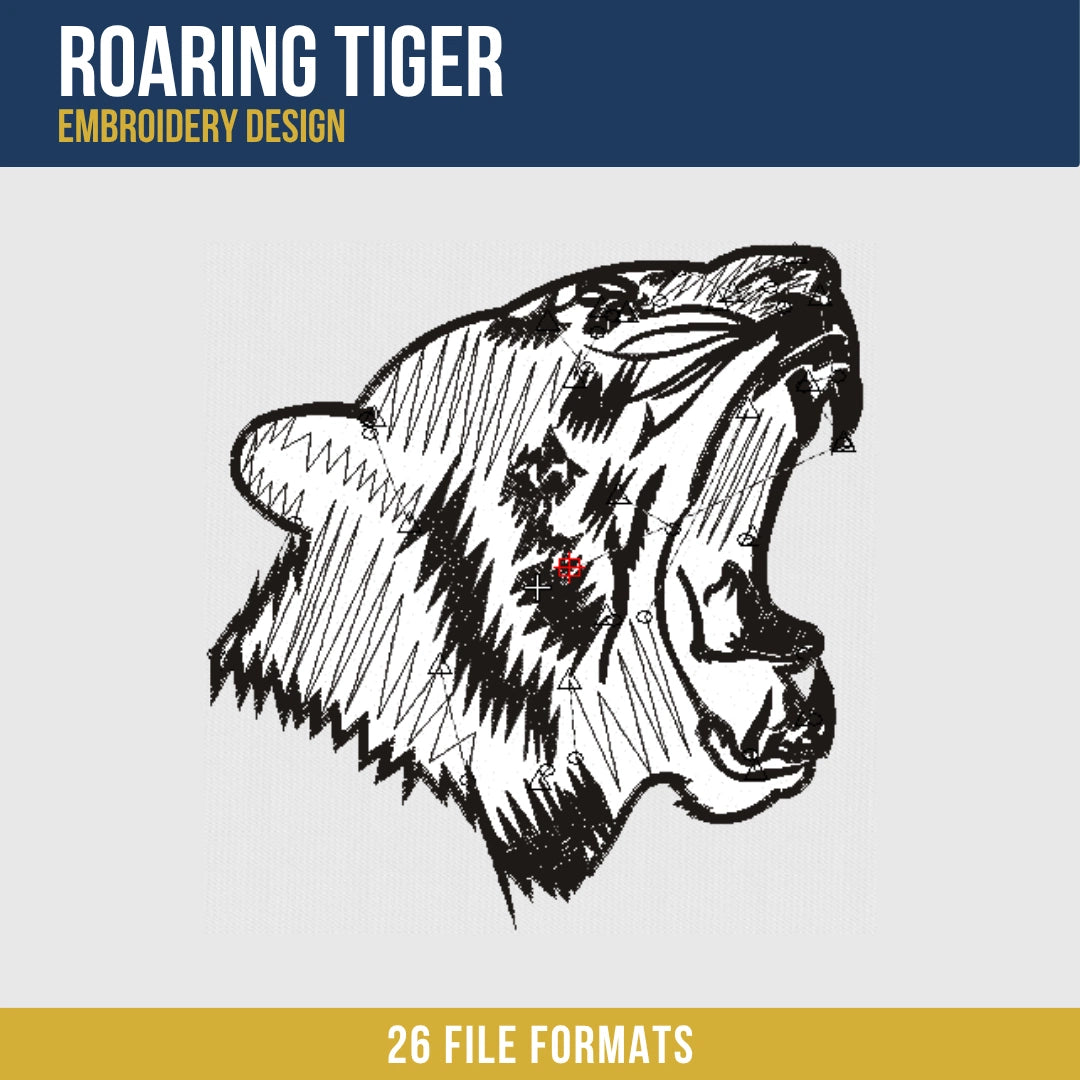
The Roaring Tiger embroidery design is a large-format white tiger head portrait rendered in a two-color construction of light grey-white and dark charcoal. The design depicts a tiger head in upward-facing profile with its jaw wide open in a full roar, exposing the upper and lower fang rows, inner jaw detail, and a curled tongue suggestion. The primary body of the head is filled with dense light grey satin stitching, with dark charcoal used for the outer contour border, stripe markings across the face and neck, fur texture line detail, inner jaw anatomy, and the individual fang and claw forms at the chin. Total stitch count is 46,972 stitches at 6.54 x 6.56 inches.
What makes this design technically distinct from other animal portrait embroideries in this collection is the fur texture rendering strategy. Rather than using smooth, direction-mapped satin fills to suggest fur as other designs do, this design uses a jagged, spike-edged silhouette combined with fine dark charcoal line stitching laid over the light grey base fill to actively simulate individual fur strand groups across the full surface of the head. The result is a design where the fur texture is a constructed surface treatment rather than a byproduct of stitch angle variation, requiring a separate layer of detail stitching that covers the entire filled head area and must be sequenced after the base fill is complete.
Design Details
The dominant element is the tiger head mass, a large irregular form occupying most of the design area and filled with dense light grey satin as the base layer. The outer silhouette of the head is intentionally jagged rather than smooth, with the fur perimeter rendered as a series of pointed spike extensions that suggest the wild, uneven texture of tiger fur at the edges of the head and neck. Over the grey base fill, dark charcoal detail lines are stitched across the face and neck in irregular grouped strokes that follow the directional growth pattern of tiger fur, converging toward the nose from the forehead, cheek, and neck areas. The stripe markings on the cheek and forehead are not simple filled shapes but ragged-edged dark patches whose irregular boundaries are formed by the termination points of the charcoal detail lines rather than by clean border outlines. The open jaw is the focal point of the right side of the composition, with upper and lower jaw edges rendered in dark charcoal satin, multiple fang forms in light grey satin with dark outline borders, and inner jaw anatomy in charcoal suggesting the tongue and palate. At the chin and lower jaw, additional claw or tooth elements extend outward in both light and dark satin. The whisker area above the jaw uses fine dark running stitch lines. The overall silhouette has no clean border; the head form dissolves into the fabric at its edges through the jagged spike perimeter.
Size Guide
| Size | Dimensions | Stitch Count |
|---|---|---|
| Standard | 6.54 x 6.56 in | 46,972 |
Formats Included
- PES, PEC - Brother, Baby Lock, Bernina
- DST, DSB - Tajima
- JEF, SEW - Janome, Elna
- VP3, VIP, SHV, HUS - Husqvarna Viking
- PCS, PCQ, PCD - Pfaff
- XXX - Singer
- ART - Bernina software
- 000 - Singer/generic
- 100 - Toyota
- CND - Melco/Conde
- CSD - Singer/POEM
- DGT - Barudan
- DSZ - Tajima older
- EMD - Elna
- EXP - Melco/Bernina
- INF - design info
Digitizing Quality
The primary technical challenge in this design is the two-layer fur surface construction. The light grey base fill must be stitched at a density that is firm enough to provide a stable foundation for the dark charcoal detail lines stitched over it, but not so dense that the subsequent detail layer causes thread buildup that raises the surface or creates needle resistance across the 6.54-inch head area. The base fill density was calibrated specifically to leave enough thread clearance for the overlying detail pass, treating the two layers as a planned composite rather than independent fills stacked arbitrarily.
The second challenge was directing the dark charcoal fur detail lines to follow anatomically correct growth directions across a complex three-dimensional head form depicted in profile. Tiger fur does not radiate from a single point but grows in region-specific directions that converge at boundaries like the brow ridge, cheek mound, and jaw hinge. Each region of the head, forehead, cheek, neck, and chin, required its own directional axis for the detail line stitching, with the line groups in adjacent regions terminating at the natural fur growth boundary between them rather than crossing into the neighboring region's direction zone.
The third challenge was the jagged spike perimeter of the silhouette. Each spike along the outer edge of the head is a pointed extension of the base fill that must taper to a clean tip without fraying or leaving a blunt stub. At 6.54 inches wide, the perimeter contains dozens of individual spike tips, each one a terminal point of the base fill where the stitch sequence ends. Managing the fill path routing so that each spike tip is approached and completed in a continuous taper rather than cut off by the fill boundary required the fill path to be explicitly routed into and out of each spike before proceeding to the adjacent section of the perimeter.
License
This file is licensed for use on finished physical goods only. You may stitch and sell embroidered items made from this design. The digital files themselves may not be resold, redistributed, shared, or included in any digital product bundle.
Instant Download
Your files are available immediately after purchase. This listing includes 1 size in all 26 embroidery formats, zipped and ready to transfer directly to your machine or software. No waiting, no requests needed. Add to cart, download, and stitch.