Bundzy
Winged Piston Embroidery Design
Winged Piston Embroidery Design
Couldn't load pickup availability
Winged Piston Embroidery Design: Biker Mechanic Machine Embroidery File
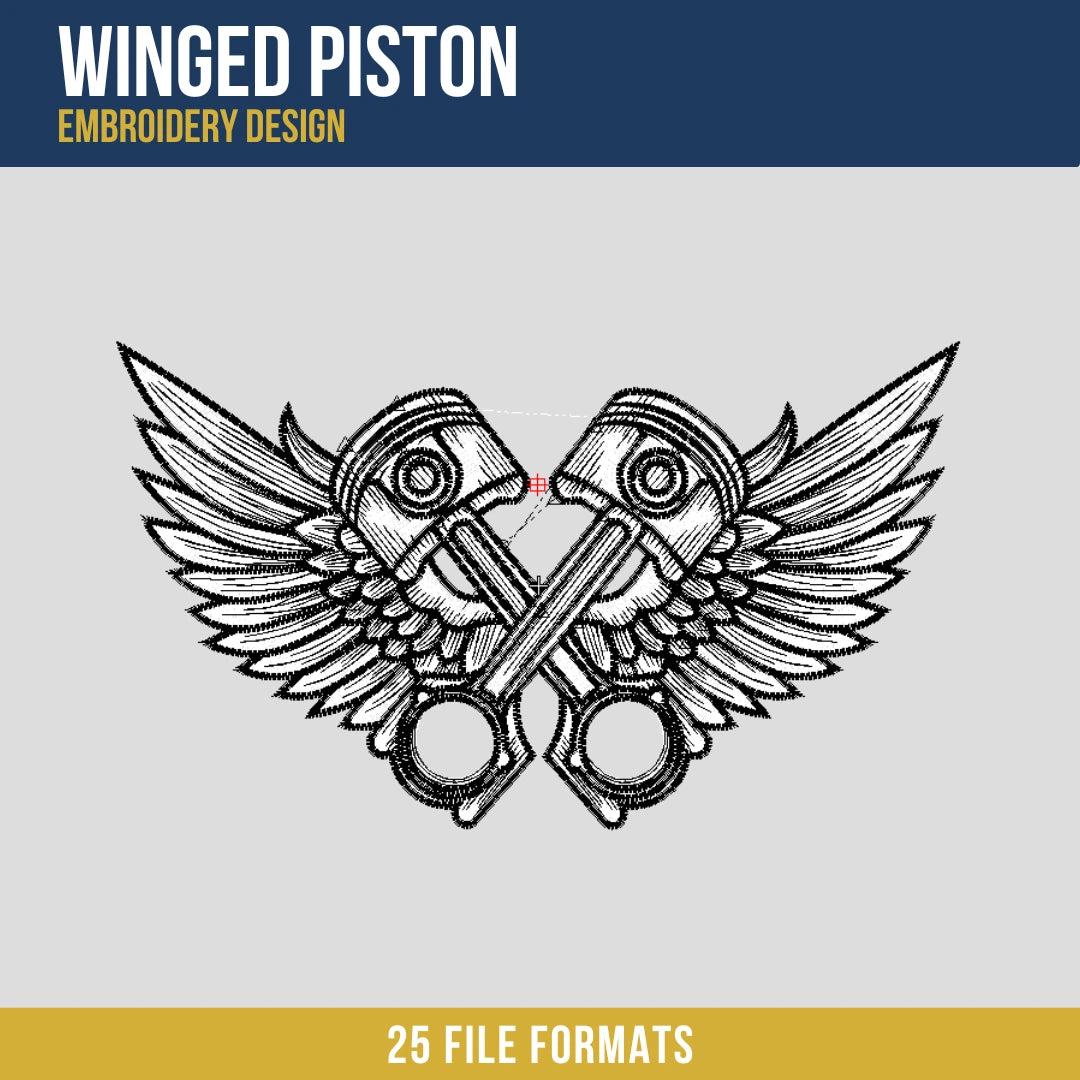
This Winged Piston embroidery design is a detailed, sketch-style machine embroidery file featuring two crossed pistons with full connecting rods and wrist pins, flanked by a large symmetrical pair of feathered wings. The design is executed in a two-tone palette of light silver-gray fill stitches with bold black outline work throughout, giving it the appearance of a hand-inked biker patch. Construction relies on dense directional fill sections for the wing feathers and pistons, with layered satin outlines defining every mechanical and organic edge. Total stitch count is 49,848 stitches.
What distinguishes this design from other winged mechanic embroidery files is the simultaneous complexity of two completely different element types sharing the same composition. The wing feathers demand long, sweeping directional fills with tight angle transitions between individual plumes, while the crossed pistons require short, precise satin columns for cylindrical surfaces, concentric ring fills for the wrist pin bores, and cross-hatched fill sections for the piston skirts. Most designs of this category simplify one element to serve the other; this file gives full technical treatment to both.
Design Details
The wings are the widest element, spanning the full width of the composition from tip to tip. Each wing is composed of multiple individual feather plumes arranged in two rows: a lower row of long primary feathers with narrow tapered tips, and an upper row of shorter secondary feathers filling the wing body. Each feather plume is filled with a directional gray fill stitch running along its length, separated from adjacent plumes by black satin stitch dividers. The wing roots converge at center behind the crossed pistons. The two pistons cross at the connecting rod shafts, forming an X at the visual center of the design. Each piston head is rendered at the top with a flat crown, a recessed top groove, and a wrist pin housing showing two concentric circular fills representing the pin bore. The piston skirts carry cross-hatched directional fill stitches suggesting machined surface texture. The connecting rods taper from the piston skirt downward to the rod-end caps at the base of the composition, each cap rendered as a circular ring with a hollow center bore. The rod shafts carry parallel directional fill stitches with a black satin outline on all edges. All mechanical edges and all feather outlines are finished with a bold black satin border, unifying the sketch-style aesthetic across both element types.
Size Guide
| Size | Dimensions | Stitch Count |
|---|---|---|
| Standard | 9.84 x 5.67 in | 49,848 |
Formats Included
- PES, PEC - Brother, Baby Lock, Bernina
- DST, DSB - Tajima
- JEF, SEW - Janome, Elna
- VP3, VIP, SHV, HUS - Husqvarna Viking
- PCS, PCQ, PCD - Pfaff
- XXX - Singer
- ART - Bernina software
- 000 - Singer/generic
- 100 - Toyota
- CND - Melco/Conde
- CSD - Singer/POEM
- DGT - Barudan
- DSZ - Tajima older
- EMD - Elna
- EXP - Melco/Bernina
- INF - design info
Digitizing Quality
The primary technical challenge in this design is managing stitch angle transitions across each individual wing feather. Because every plume is oriented at a slightly different angle relative to the wing arc, the fill direction must shift incrementally from feather to feather without producing visible pull distortion at the satin dividers between them. The digitizer has mapped each plume as an independent fill zone with its own stitch angle, and underlay has been applied beneath each zone to stabilize the fabric before the top fill locks in.
The concentric ring fills on the piston wrist pin bores presented a separate challenge. Circular satin fills at small diameters create significant inward pull on the fabric if density is not carefully reduced toward the center. Density stepping was applied to each bore ring so that thread count decreases as the fill approaches the center point, preventing fabric distortion and keeping the bore opening visually clean and round on the finished piece.
At nearly 50,000 stitches across a 9.84 x 5.67 inch footprint, overall density management across the full design was critical. The wings and the pistons both carry dense fill coverage, and without careful sequencing the cumulative thread weight could cause the base fabric to distort or the design to shift during stitching. The stitch sequence moves from the outer wing tips inward toward center, allowing each completed section to stabilize before adjacent dense areas are laid down.
License
This design is licensed for commercial use on finished physical goods. You may sell embroidered items made with this file without per-item royalty. Digital files, including all included formats, may not be resold, redistributed, or shared in any form, whether modified or unmodified.
Instant Download
Files are available immediately after purchase. This listing includes 1 size in 25 file formats, covering every major home and commercial embroidery machine brand. Download, unzip, and load directly into your machine or embroidery software.