Bundzy
Yin Yang Koi Fish Embroidery Design
Yin Yang Koi Fish Embroidery Design
Couldn't load pickup availability
Yin Yang Koi Fish Embroidery Design: Japanese Koi Pair Machine Embroidery File
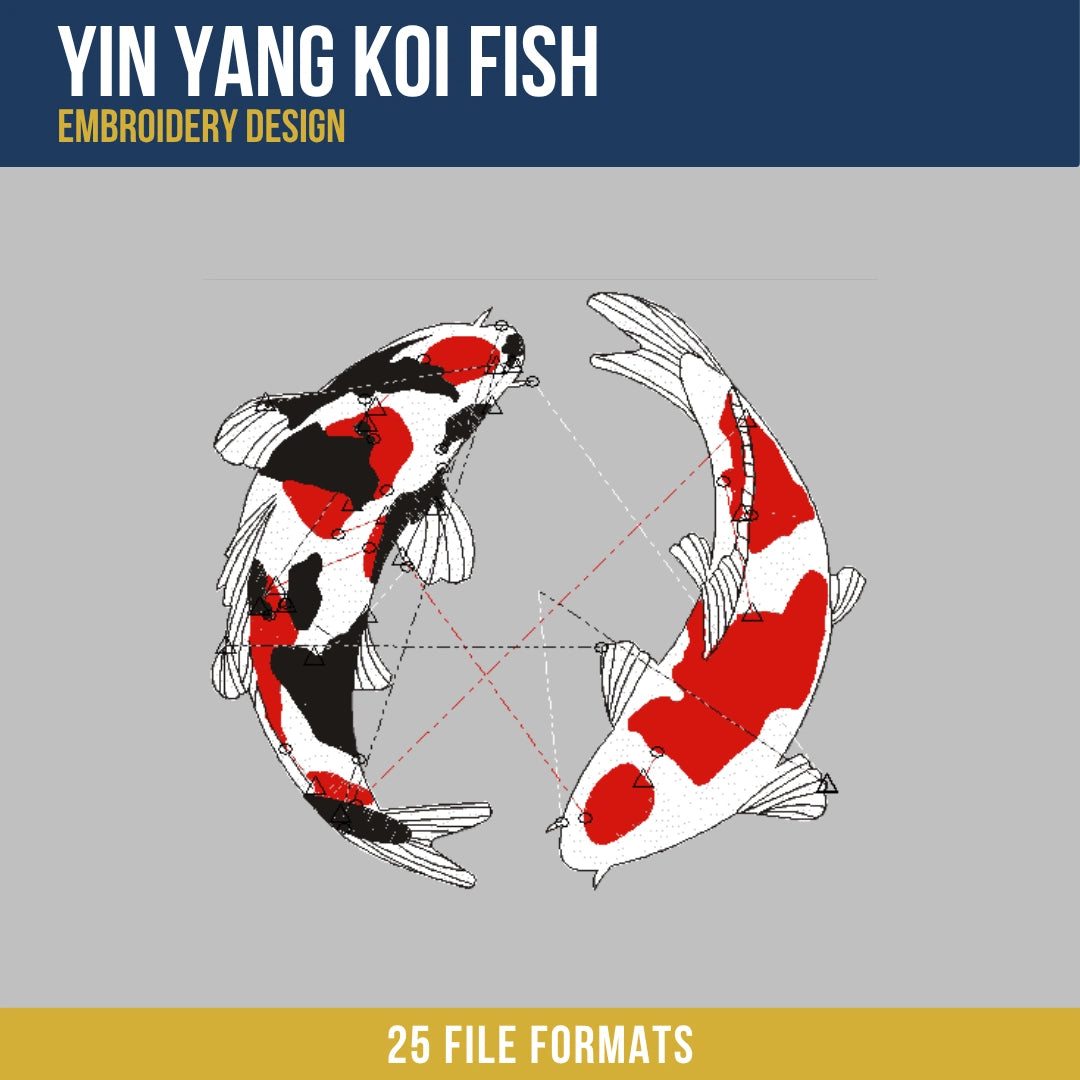
This Yin Yang Koi Fish embroidery design is a richly detailed machine embroidery file featuring two mirrored koi fish arranged in a circular yin yang composition, rendered in a three-color palette of white, red, and black thread. Each fish is constructed with smooth directional body fills, irregular patch fills for the koi color markings, fine satin stitch scale line detailing, and delicate directional fills across the fins and tail sections. The two fish face opposite directions and curve around each other to complete the circular balance of the composition. Total stitch count is 42,932 stitches.
What distinguishes this design from other koi embroidery files is that the two fish are not identical mirror copies. The left fish carries a denser black marking pattern with bold black patches across the dorsal and tail regions, while the right fish is predominantly white-bodied with red markings only, carrying no black patches at all. This deliberate asymmetry in color distribution between the two fish is what gives the composition its true yin yang character, and it requires each fish to be independently digitized with a different color sequence rather than simply duplicating and flipping a single fish file.
Design Details
The left fish is the more complex of the two, oriented with its head pointing upper-right toward the center of the composition. The body base fill is white with a smooth directional fill running along the body length. Atop the base layer, red patch fills cover the cheek area behind the mouth, a broad mid-body section, and a smaller patch near the tail root. Black patch fills overlay sections of the dorsal region, a band across the mid-body overlapping the red, and the rear dorsal fin. The pectoral fins are rendered in white with fine parallel line fills suggesting translucent fin rays, bordered by a light gray outline. The tail fin fans out in a wide spread with individual lobe fills separated by satin stitch ray dividers. The mouth is defined by a small satin stitch tip. The right fish mirrors the circular arc of the left, with its head pointing upper-left. Its body base is the same white fill, but the color patch distribution is entirely different: red patches cover the dorsal saddle, a large mid-body area, and a tail-base patch, while the body carries no black markings at all. The fins and tail of the right fish repeat the translucent ray fill treatment used on the left fish. Both fish are outlined along all body edges with a fine black satin border that defines the silhouette against the ground fabric.
Size Guide
| Size | Dimensions | Stitch Count |
|---|---|---|
| Standard | 8.74 x 7.95 in | 42,932 |
Formats Included
This design is delivered in 25 file formats compatible with all major machine brands: PES, PEC (Brother, Baby Lock, Bernina) | DST, DSB (Tajima) | JEF, SEW (Janome, Elna) | VP3, VIP, SHV, HUS (Husqvarna Viking) | PCS, PCQ, PCD (Pfaff) | XXX (Singer) | ART (Bernina software) | 000 (Singer/generic) | 100 (Toyota) | CND (Melco/Conde) | CSD (Singer/POEM) | DGT (Barudan) | DSZ (Tajima older) | EMD (Elna) | EXP (Melco/Bernina) | INF (design info)
Digitizing Quality
The most demanding technical challenge in this design is achieving clean color layering on the koi body patches. The red and black markings are not simple applique shapes; they sit on top of the white body base fill, which means the underlay beneath each patch must be timed to grip the already-stitched base layer without causing the top patch fill to sink into the previous stitching. Each patch zone uses a cross-hatch underlay at reduced density specifically tuned to lock onto the white base without compressing it, keeping patch edges crisp and preventing color bleed at the boundaries.
The fin ray fills presented a separate challenge across both fish. Each fin is composed of multiple narrow lobes separated by satin stitch dividers, and because the lobes taper to fine points at their tips, stitch density must decrease progressively toward each tip to prevent thread buildup and puckering. The digitizer applied tapered column fills to each lobe rather than uniform density fills, so the thread weight reduces naturally as the lobe narrows.
Sequencing the two fish within a single file without introducing excessive jump stitches between them required careful planning. Because the fish interlock in a circular composition with overlapping tail and fin areas near the center, the color sequence was organized to complete all white base fills across both fish first, then layer all red patches, then all black patches, minimizing color changes and keeping the overall jump stitch count low across the full 42,932 stitch run.
License
This design is licensed for commercial use on finished physical goods. You may sell embroidered items made with this file without per-item royalty. Digital files, including all included formats, may not be resold, redistributed, or shared in any form, whether modified or unmodified.
Instant Download
Files are available immediately after purchase. This listing includes 1 size in 25 file formats, covering every major home and commercial embroidery machine brand. Download, unzip, and load directly into your machine or embroidery software.